Getting Up Close to the Animals at Chicago’s Lincoln Park Zoo
· Updated · BootsnAll
 Lincoln Park Zoo started in 1868 with a gift of two pairs of swans from the commissioners of New York's Central Park, and it has never charged admission since (Wikipedia). That makes it one of the oldest zoos in the country and one of very few big ones you can walk into for free. It's open 365 days a year, and it sits right in Lincoln Park, between the lakefront and the neighborhood's brownstones, so it's easy to fold into a walk rather than plan a whole day around it.
The zoo covers 49 acres and has nearly 200 species, according to its website. Polar and grizzly bears, lions, giraffes, black rhinos, gorillas, chimpanzees, Japanese macaques, African penguins, harbor seals and red pandas are all here. It's compact, most of the big habitats have been rebuilt since the early 2000s, and you can see the whole place in two or three hours.
The basics
Admission: Free. About 80% of the zoo's operating costs come from members, donors and visitors, and a Chicago Park District subsidy covers the rest.
Hours: Gates open at 8am and buildings at 10am every day. Buildings close at 4:30pm and gates at 5pm, but special events can close things early, so check the hours page before you go.
Address: The main East Gate is at 2400 N. Cannon Drive, next to the paid parking lot. Taxis and rideshares should drop you at the West Gate, near Stockton Drive and Webster Avenue.
Rules: No pets (service animals are fine), no outside alcohol and no smoking.
What to see
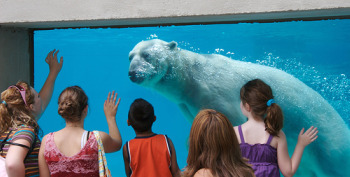
Walter Family Arctic Tundra, in the northeast corner, replaced the old bear line with a bigger habitat for polar bears and grizzlies, with grass instead of concrete rockwork and an underwater viewing window.
Regenstein African Journey is the zoo's largest building, a 60,000-square-foot indoor and outdoor walk through African habitats. Inside you'll find dwarf crocodiles, pygmy hippos and meerkats, and outside there are the giraffes, the rhinos and a yard for African painted dogs. It's the place to go on a cold or rainy day.
Regenstein Center for African Apes has the gorillas and chimpanzees behind big glass panels, and the ape care demonstration at 1pm is worth timing your visit around.
Regenstein Macaque Forest, by the West Gate, is home to a troop of Japanese macaques (snow monkeys) with their own heated "hot spring." They're at their best in winter.
Pepper Family Wildlife Center is the zoo's lion house. The landmark building dates from 1912 and reopened in 2021 after a $30 million renovation that turned it over to African lions.
Robert and Mayari Pritzker Penguin Cove is an outdoor habitat for African penguins, a warm-weather species that also copes with Chicago winters.
Nature Boardwalk, on the south end, is a restored pond with native wetland plants and a boardwalk loop, with a view of the skyline. It's free, it's quiet, and most visitors walk right past it. Fishing isn't allowed.
Families should also look for the Farm-in-the-Zoo, where kids can help groom the goats and feed the cows and chickens, and the Pritzker Family Children's Zoo, with beavers and river otters you can watch underwater.
Free demonstrations and paid extras
The zoo runs free daily keeper talks. The things to do page lists seal training at the Kovler Seal Pool at 11:30am and 2:30pm, the ape demonstration at 1pm and penguin feeding at 2pm, plus a free garden walk on the second Saturday of the month. The zoo is an accredited arboretum, too, so the plantings get as much care as the animals. Schedules change with the animals' needs and the weather.
The paid extras are optional. The Lionel Train Adventure and the Endangered Species Carousel cost $4.50 a ride. The zoo also sells behind-the-scenes tours, sunset garden tours and a 60-minute penguin encounter for ages six and up, and members pay less.
ZooLights
ZooLights is the zoo's holiday light show. It runs from late November to early January, with millions of lights, a light tunnel, a Ferris wheel and s'mores by the fire pits. It's ticketed, with cheaper tickets if you book a date in advance, and admission is free on most Mondays, when tickets are released a week ahead. Details are on the ZooLights page, and our Christmas events page has more holiday ideas.
Getting there
Take the bus. The 22, 36, 151 and 156 all stop along the zoo's western edge, and the 151 runs straight up Michigan Avenue from the Loop. By train, the Red Line's Fullerton stop and the Brown and Purple lines' Armitage stop are both about a mile west, a pleasant walk through the neighborhood. See our guide to neighborhoods to visit by public transportation for more.
Driving works, but it isn't cheap. The zoo's lot at Fullerton Parkway and Cannon Drive is free for the first half hour and then runs $35 to $45 a day, card only. Members get free or discounted parking. There are bike racks at the main gates and several Divvy stations nearby.
Make a day of it. The Chicago History Museum is at the south end of the park, North Avenue Beach is a short walk east (see our beaches page), and there's plenty more in our family fun in Chicago guide.
Photo by Karl Heubaum