Easy Day and Overnight Trips from Chicago
· Updated · BootsnAll
 You can get a good feel for Chicago in three days. You won't see everything, but you'll get the idea, and if you're coming from somewhere nearby, there's no shame in a long weekend. With more time, though, it's worth getting out of the city for a day or a night. Chicago is better set up for this than most American cities, because a lot of the good trips start at a train platform, not a rental counter.
Here's where we'd go, roughly in order of how easy it is to get there without a car.
Oak Park
This is the easiest half-day trip from downtown. Oak Park sits right on the city's western edge, and the CTA Green Line runs from the Loop to the Oak Park and Harlem/Lake stops for the price of an L ride. Frank Lloyd Wright spent the first 20 years of his career here, and his Home and Studio, Unity Temple and blocks of Prairie-style houses are all within walking distance of each other. Ernest Hemingway was born a few blocks away, and his birthplace is now a museum. Book the Wright tours ahead in summer. Our Oak Park page has the tours, hours and where to eat.
Evanston
Evanston is the first suburb north of the city, on the lake, and home to Northwestern University. Take the CTA Purple Line or Metra's Union Pacific North Line to Davis Street, where the downtown starts, with more than 85 restaurants and a mix of independent shops within a few blocks (Wikipedia). Walk east to the lakefront and the Northwestern campus, then eat downtown before heading back. Main Street, farther south, has its own cluster of boutiques with both CTA and Metra stops.
Indiana Dunes National Park
If you only take one trip out of the city, make it this one. Indiana Dunes became the country's 61st national park in 2019, and it runs about 15 miles along the southern shore of Lake Michigan (Wikipedia). You get beaches, sand dunes and marsh and prairie trails. Mount Baldy, at the east end, is a 123-foot dune that moves about four feet a year.
You don't need a car. The South Shore Line leaves from Millennium Station under Millennium Park and stops at four stations in and around the park, according to the park service. Dune Park is the most useful one. From there it's a 1.33-mile walk south on the Dunes Kankakee Trail to the Indiana Dunes Visitor Center, or a mile north on the same trail to the entrance of Indiana Dunes State Park, the older, separate state park in the middle of the national park. From Beverly Shores station, it's about a mile's walk north on Broadway Avenue to Lake View Beach. A full-fare one-way ticket from downtown is $10 to Dune Park and $11 to Beverly Shores (fare table). Some weekend trains take bikes, and Dune Park is the only station in the park where you can board with one. Check the timetable, since trains on weekends are less frequent and missing the last one back is a real problem.
Keep going on the same line and you reach South Bend and Notre Dame. See our South Bend page for that trip.
Milwaukee
Milwaukee is about 90 miles north, and it's the best big-city day trip from Chicago. Amtrak's Hiawatha runs six round trips a day (five on Sunday) and takes about an hour and a half from Union Station to downtown Milwaukee, which beats most drives. The Hiawatha leaves you at the Intermodal Station, and the Hop streetcar runs from there to the Third Ward and downtown. Go for brewery tours, the Milwaukee Public Market and the Calatrava wing at the art museum, or book a hotel and stay for a Brewers game. See getting between Milwaukee and Chicago for trains and buses, and things to do in Milwaukee for the rest.
Michigan's harbor towns
Across the state line, the southwest Michigan shore is where Chicagoans go for summer weekends. Closest in is Harbor Country, the string of small beach towns around New Buffalo. A bit farther up are St. Joseph and, next to it, Benton Harbor. Farther still is Saugatuck, an old art colony with dune views from Mount Baldhead and Oval Beach, one of the best-known beaches on the lake (Wikipedia). The first version of this page lumped all three together as "Harbor Country." They're spread out along the shore, so pick one per trip.
Some of them you can reach by train. Amtrak's Wolverine stops in New Buffalo three times a day in each direction, and the Blue Water once a day (Wikipedia). The Pere Marquette runs once a day between Chicago and Grand Rapids, stopping at St. Joseph, Bangor and Holland (Wikipedia). It leaves Chicago after the afternoon rush and comes back from Michigan in the morning, so it works for a weekend, not a day trip. For Saugatuck, and for getting between towns, you'll want a car. These towns fill up in summer and empty out in winter, when some shops and restaurants close for the season. Remember that Michigan is on Eastern Time, an hour ahead of Chicago.
Lake Geneva
Lake Geneva, Wisconsin, is about 75 miles northwest of Chicago (Wikipedia). Rich Chicagoans started building summer mansions on the lake in the late 1800s, which earned it the nickname "Newport of the West," and a lot of those houses are still there. The best way to see them is from the water. Lake Geneva Cruise Line runs one- and two-hour narrated tours, and its US Mailboat Tour is the one people talk about. Mail jumpers leap from the moving boat to the piers to deliver mail to about 75 lakeside residents. It's seasonal, so check the schedule before you plan around it.
Driving is the practical way to get here. The old version of this page suggested Metra and a resort shuttle. Metra's Union Pacific Northwest Line does run as far as Harvard, Illinois, but most trains end at Crystal Lake, and from Harvard you'd still need a ride over the state line (Wikipedia). If you're not driving, call your hotel before you book and ask what they can arrange.
Starved Rock State Park
Starved Rock, near Utica on the Illinois River, is the most visited state park in Illinois, and the reason is its 18 sandstone canyons. There are more than 13 miles of trails, and many of the canyons have waterfalls after rain or snowmelt, so early spring is the time to go. By midsummer a lot of them are down to a trickle. The trails are open from 7am to sunset.
You need a car. Starved Rock Lodge says it's less than two hours from Chicago. The lodge was built by the Civilian Conservation Corps in the 1930s, it's on the National Register of Historic Places, and it's the only place to stay inside the park, with rooms and log cabins. Otherwise there's the park campground, or a hotel in one of the nearby towns. Matthiessen State Park, a few miles south, has canyons of its own and makes a good second stop.
Galena
Galena is in the far northwest corner of Illinois, near the Mississippi, and it's the longest drive on this list, so plan to stay the night. In the 1840s it was a lead-mining boomtown and a steamboat hub, and a lot of that town is still standing. About 85 percent of the town is in the Galena Historic District, which includes more than 800 properties (Wikipedia). Walk Main Street, then climb up to the streets above it for the houses.
Ulysses S. Grant lived here, and the Ulysses S. Grant Home is a state historic site. In summer it's open Wednesday through Sunday. Check the site for hours the rest of the year. For the night, the DeSoto House Hotel has been open since 1855 and calls itself Illinois' oldest operating hotel. There's no passenger train to Galena, so you'll need a car. On busy weekends, downtown parking fills up. The visitor bureau has a parking map.
Route 66
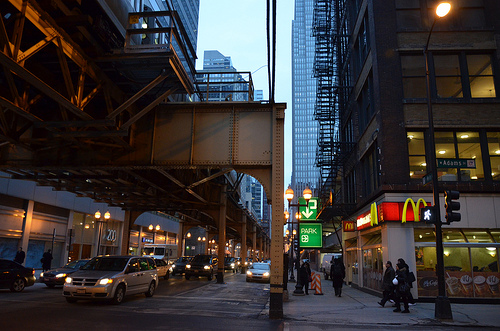
Route 66 starts in the Loop, at the "Begin Historic Route 66" sign on Adams Street just west of Michigan Avenue. Have breakfast at Lou Mitchell's, pick up a rental car, and drive southwest. With a day, you can reach Joliet, Wilmington's Gemini Giant and Pontiac and be back by dinner. With a weekend, go as far as Springfield, which has the most to see on the Illinois stretch, plus the Lincoln sites. Our Route 66 page has the stops, and you can take the train home from Springfield if you book a one-way rental. For that route, see getting between St. Louis and Chicago. If you keep going, St. Louis is where the road crosses the Mississippi.
For more ideas that don't leave the city, see neighborhoods to visit using public transportation and Chicago's beaches.
Photo by thomas.merton