Chicago-Style Hot Dogs and the Vienna Beef Story
· Updated · BootsnAll
 Visitors come for the deep-dish pizza. Chicagoans eat hot dogs. Walk up to almost any stand in the city and the frank in your poppy seed bun was made by Vienna Beef, a company that has been stuffing sausages on the West and South Sides since the 1890s.
What goes on a Chicago dog
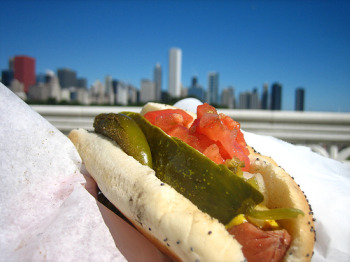
Start with an all-beef frank, steamed or simmered in water (a few stands char-grill theirs), in a steamed poppy seed bun. Then it gets "dragged through the garden" with seven toppings: yellow mustard, chopped white onion, that neon-green sweet relish, tomato slices or wedges, a dill pickle spear, a couple of sport peppers and a shake of celery salt. It's the same seven that come in Vienna Beef's home kit, though a few old-school stands still serve a stripped-down Depression version (more on that below).
Ketchup doesn't make the list. You can ask for it, and some places will hand it over, but expect a look. Gene & Jude's doesn't stock it at all. Asked about ketchup, Vienna Beef's then-CEO Jim Bodman said, "Good Lord, no! You'll get me shot" (Mashed).
The toppings came together during the Depression, when street vendors sold a nickel dog loaded with cheap produce so it counted as a meal. Food historian Bruce Kraig, professor emeritus at Roosevelt University, credits the city's immigrant groups for the pieces. Per WBEZ, his version goes: mustard from the Germans, onions and tomatoes from the Greeks, sweet relish from the Czechs, sport peppers from the Italians.
Vienna Beef, from the 1893 World's Fair to Bridgeport
The company's founding story goes like this. Emil Reichel and Sam Ladany, Jewish immigrants from Austria-Hungary, sold their family-recipe all-beef frankfurters to crowds at the 1893 World's Columbian Exposition, then stayed. In 1894 they opened a storefront on Halsted Street on the West Side, near Roosevelt Road, selling sausage and bologna. That's the account in Vienna Beef's own history, Wikipedia and just about every Chicago food history. Nobody has turned up a record of the fair stand itself, so the 1893 part rests on the company's word.
Distribution spread to other Midwestern states around 1950, and Vienna products hit supermarkets in the 1960s. Senior vice president Tom McGlade says there are more Vienna Beef stands in the area than McDonald's, Wendy's and Burger King locations combined (News Tribune, July 2026). Stands that have served the brand for decades get inducted into the company's Hot Dog Hall of Fame.
How the dogs get made
Vienna's recipe is all beef, no pork, which is still the dividing line between a Chicago frank and a lot of what gets sold elsewhere. When Time Out Chicago walked through the process with the company, about 75 percent of the meat was ground domestic beef from older cattle and the other 25 percent was trimmings from fatty cuts like brisket and navel. The beef, salt, garlic and paprika get blended into a thick paste in an industrial mixer and stuffed into casings.
The classic stand dog uses a natural sheep casing. That's where the snap comes from when you bite in. Vienna also makes skinless franks. The links go on racks into a smoking room where hickory smoke cooks and flavors them. The company still describes its franks as "hickory-smoked" made from "premium domestic beef," using the same recipe it has used for more than 130 years (company statement, June 2026).
The old Fullerton plant and where production is now
For decades the hot dogs came out of the plant at 2501 N. Damen Ave., where Damen, Elston and Fullerton meet the Chicago River in Bucktown. It's the factory most Chicagoans still picture, and it had its own cafe out front. Production there is over. Vienna moved production to a facility in Bridgeport in 2015 and closed the Bucktown cafe and store in 2020. I couldn't find any public factory tour running today. Vienna's Hot Dog University, a two-day course for people who want to open their own stand, is the closest thing.
Two things to know if you want to go to the source. The Vienna Beef Factory Store at 3847 S. Morgan St. in Bridgeport sits across from the plant, with a counter for hot dogs and corned beef or pastrami sandwiches and deli meats to take home. It's closed Sundays, and hours have shifted over the years, so check before you head down. Back in Bucktown, the old factory is now Vienna Beef Plaza, the company's headquarters, with a Binny's already open. A new cafe and factory store there has slipped several times, partly because Vienna has been building out its pickle business in Ohio and California. As of August 2026 the company is aiming for spring 2027 (Block Club Chicago).
Vienna Beef outside Chicago, and Portillo's
You don't need to be in Chicago to eat one. Vienna sells franks, buns and full topping kits from its online shop, and ships nationwide through Goldbelly. Grocers outside Illinois carry it too, like Heinen's in Ohio. And Hot Dog University graduates have opened stands as far away as southwest Florida. Vienna has a stand and store locator if you're hunting for one near home.
The biggest reason most Americans have tasted a Vienna dog is Portillo's. Dick Portillo opened it as The Dog House in 1963, in a 12-foot trailer in Villa Park with no running water. Vienna says Portillo's has served its franks "from the beginning in 1963," and gave the chain its first Legends Award when it inducted the original Villa Park location into the Hall of Fame in 2014 (Vienna Beef).
Portillo's went public on Nasdaq in October 2021 under the ticker PTLO. As of June 28, 2026 it had 109 restaurants in 11 states, per its second-quarter results. Chicagoland still has the biggest cluster, but you'll find them in places like Arizona, California, Florida and Texas, which got six new ones in the first half of 2026, plus an airport location at Dallas-Fort Worth. This summer the two companies released the Char'diniera Dog, a limited-run char-grilled Vienna frank with giardiniera and provolone mixed into the meat.
In the city, the Portillo's at 100 W. Ontario St. in River North is the one visitors end up at. It's big, loud, open late, and dressed up like a Prohibition-era gangster hangout. Get a Chicago dog and an Italian beef, split them, and don't skip the chocolate cake shake.
Chicago hot dog stands worth the trip
Portillo's is reliable, but the stand experience is its own thing. These are all open as of September 2026. For more cheap eating around town, see Chicago's best cheap eats.
- Gene & Jude's, 2720 N. River Rd., River Grove. Open since 1946, no seats, no ketchup. They serve a Vienna frank the Depression way: mustard, onion, relish and sport peppers, with a pile of hand-cut fries dumped right on top. It's just past the city line and open late.
- Superdawg, 6363 N. Milwaukee Ave. A 1948 drive-in with carhops, speaker boxes and Maurie and Flaurie, the giant hot dog figures, still on the roof. Superdawg uses its own frank, not Vienna, and serves it with a pickled green tomato, packed in a little box with crinkle-cut fries. There's a second location in Wheeling.
- The Wieners Circle, 2622 N. Clark St., Lincoln Park. Char-grilled Vienna dogs since 1983. By day it's a normal hot dog stand. After the bars close on weekends it turns into a shouting match between staff and customers, and people come for the show as much as the dog.
- Jim's Original, 1250 S. Union Ave., near UIC. Open since 1939 and credited with the Maxwell Street Polish, a grilled Polish sausage with grilled onions and mustard. They also do a pork chop sandwich with the bone in. UIC told Jim's to leave this spring, then agreed in June to let it stay for now. The stand has bought the old Ken Tone's Drive-In at 551 W. 18th St. in Pilsen for an eventual move, where the owner plans to bring back 24-hour service (Block Club Chicago).
- Byron's Hot Dogs, 1017 W. Irving Park Rd., at the edge of Lakeview near Graceland Cemetery. A Vienna Hall of Famer since 2006 with a long menu, and an easy stop if you're headed to Wrigley. More options up that way are in where to eat and drink near Wrigley Field.
Hot Doug's
This page used to send you to Hot Doug's at 3324 N. California Ave. in Avondale, where Doug Sohn served foie gras sausage, wild boar and duck-fat fries to a line out the door. It closed for good on October 3, 2014. When the city banned foie gras in 2006, Sohn kept selling it and named a foie gras dog after the alderman behind the ban. He got fined, and the city repealed the ban in 2008.
Photo by adactio