Walking through History at the Field Museum
· Updated · BootsnAll
 The Field Museum grew out of the 1893 World's Columbian Exposition, took its name from Marshall Field, the department-store man who paid for it, and moved into its Daniel Burnham-designed building on the lakefront in 1921. It now holds more than 24 million specimens and objects, and only a sliver is on display. That sliver still takes most of a day.
For a quick pass, give it an hour and stick to the main floor and SUE. To do it justice, plan on at least two and a half hours. You could easily spend four or five.
The dinosaurs
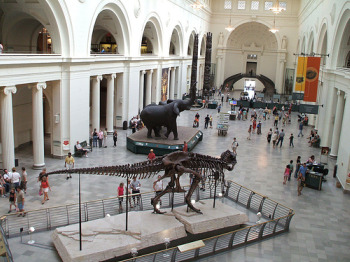
You meet two of them before you've shown your ticket. Stanley Field Hall, the huge main hall, has Máximo, a cast of the titanosaur Patagotitan mayorum that stretches 122 feet and stands 28 feet tall at the head. It's modeled on bones dug up on a ranch in Argentina, and you can walk right underneath it. Overhead hangs Sobek, a 46-foot Spinosaurus mounted as if it's swimming, which the museum says is the only Spinosaurus skeleton on display outside Asia.
SUE is upstairs. She used to stand in the main hall, where she was the first thing everyone saw, and in December 2018 she moved to her own gallery within the Griffin Halls of Evolving Planet. She's 40 feet long and about 90% complete, one of the largest and most complete T. rex skeletons ever found, though a Canadian specimen called Scotty may be slightly bigger. The gallery gives her a proper setting, with a mural of her world 67 million years ago and a station where you can smell what her breath might have been like. The rest of Evolving Planet covers 4.5 billion years in 27,000 square feet. Look for the Tully Monster, an odd creature discovered in Illinois and now the state fossil.
Beyond the bones
The man-eating lions of Tsavo are the other celebrities. Two maneless males killed railway workers in Kenya in 1898, and the British engineer who shot them sold their skins to the museum in 1925, after using them as rugs. He claimed 135 victims. Field Museum scientists who tested the lions' bones and hair put the number closer to 35. A third man-eater, from Zambia, is on the ground floor.
Inside Ancient Egypt is on the ground floor. It includes a burial chamber dating to around 2400 BC and holds 23 human mummies and more than 30 animal mummies. The museum's cultural hall on Africa closed in October 2025 for a rebuild that will fold Egypt into it, with reopening planned for 2028, so check what's open before you set your heart on the mummies.
In the Pacific halls you can step inside Ruatepupuke II, a carved Māori meeting house built in 1881 at Tokomaru Bay in New Zealand. It's one of only three outside the country, and it's still used for gatherings in the spirit of the original.
The Grainger Hall of Gems has a collection older than the museum. Tiffany & Co. showed its gem collection at the 1893 fair, and the fair's president bought the lot and donated it. Now it has more than 600 gemstones, a 3,400-year-old Egyptian garnet necklace, and a 97.45-carat imperial topaz, the largest owned by any museum.
The temporary shows change and usually need an add-on ticket. The Pokémon Fossil Museum, which puts Pokémon fossils next to real ones, runs through April 11, 2027. See the exhibitions page for what's on.
Tickets and hours
General admission starts at $30, or $21 for Chicago residents, and CityPASS lists the child price at $23. Kids under 3 are free, and seniors and students get $3 off. Illinois residents get in free every Wednesday. Book online ahead, since those days fill, and bring proof of residency. Families with a Link or WIC card from any state pay $3 a person for up to six. The Field is on both CityPASS and Go City, and our pass comparison works out whether either saves you money.
The museum is open daily from 9am to 5pm, with last entry at 4pm, and closes only on Thanksgiving and Christmas. On select Legendary Late Hours dates it stays open until 9pm, which makes an evening visit possible.
Getting there
The Field is at 1400 S. DuSable Lake Shore Dr., between Soldier Field and the Shedd Aquarium. The nearest L stop is Roosevelt (Red, Orange and Green lines). From there it's a walk east over the tracks and under Lake Shore Drive, or you can catch the #146 bus at State and Roosevelt, which runs to the Museum Campus. The #130 adds service from mid-May through Labor Day, and Metra Electric stops at Museum Campus/11th Street. Driving is expensive. The Soldier Field North Garage charges $27 for up to four hours and $32 for up to 12, and Bears games and summer concerts push prices and traffic up. On a nice day, rent a Divvy bike and take the Lakefront Trail.
If you're pairing the Field with a second museum, the Adler Planetarium is a walk out along the lake, past the Shedd. Doing all three campus museums in a day is too much.
Photo by pobrecito33