Five Best Exhibits at the Museum of Science and Industry
· Updated · BootsnAll
 Chicago's Museum of Science and Industry, officially the Griffin Museum of Science and Industry since 2024, has more than 2,000 exhibits in 75 major halls inside the old Palace of Fine Arts from the 1893 World's Fair. Walk in without a plan and you'll spend half the day finding your way around. You can see the best of it in four or five hours if you pick your spots, and these are the ones I'd pick.
Two of them need their own timed tickets on top of general admission, the U-505 On-Board Tour and the Coal Mine. Both have limited space, so book them online when you buy your admission and schedule them a couple of hours apart. Our visitor guide has prices, hours and discounts, and how to get there covers the trip down from the Loop. You're allowed to bring your own lunch and eat it in the designated areas inside or on the front lawn, or see where to eat nearby.
The U-505 Submarine
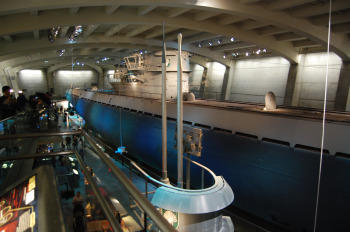
This is the one to build your day around. The U-505 is a real German U-boat, captured by the US Navy on June 4, 1944, and it's the only German submarine on display in the US. The Navy kept the capture secret for the rest of the war, and the exhibit is good on how they pulled that off.
The sub arrived in 1954 and sat outdoors beside the museum for 50 years while the Chicago weather worked on it. Restoration started in 2004, and the indoor exhibit opened on June 5, 2005. It's a National Historic Landmark and a national war memorial to American sailors. You walk down through galleries of wartime artifacts, nearly 200 of them, and interactive stations: a periscope game, a buoyancy challenge in an 11-foot water tank, and touch screens where you try to crack an Enigma code. Then the room opens up and the whole boat is in front of you.
The exhibit comes with general admission. Going inside the boat costs extra, $18 for adults and $14 for kids, on the U-505 On-Board Tour. It takes about 25 minutes and it's worth it. The U-505 had 59 men aboard and 35 bunks, so most of the crew slept in shifts in beds still warm from the last man, and once you're inside you'll see how that worked. Allow 5 to 10 minutes to get from the exhibit entrance to the tour entrance, because latecomers don't get in. The tour isn't accessible for wheelchairs or strollers. On the way out, the Mold-A-Rama machine by the entrance will mold you a plastic U-505 while you wait.
The Transportation Gallery
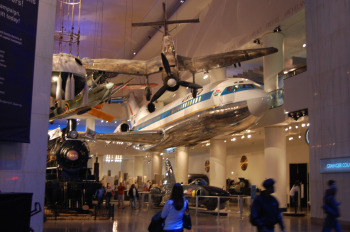 You can't miss the Transportation Gallery. Look up and there's a formation of early planes hanging from the ceiling, including a 1917 Curtiss "Jenny" biplane caught upside down in a barrel roll, and a British Spitfire chasing a German Stuka dive-bomber, one of only two Stukas left in the world. On the floor is the 999 "Empire State Express" steam locomotive, which the museum says hit 112.5 mph on May 10, 1893, making it the fastest land vehicle of its day. You can climb aboard.
Upstairs on the balcony is Take Flight, built around a real United Airlines Boeing 727, the first 727 in commercial service. You can walk through it. One wing is off and panels are cut away to show the wiring and hydraulics, and the cabin is set up the way it looked on its first flights in 1964. Real United pilots volunteer there and will talk flying if you ask.
In the middle of the gallery is The Great Train Story, a 3,500-square-foot HO-scale railroad with more than 20 trains on 1,400 feet of track, running from Chicago to Seattle through the Plains, the Rockies and the Cascades. Buttons around the edge let you raise a drawbridge, set off tunnel blasts and fell trees, and twice an hour the lights drop for night mode. Look for the CTA Red Line station at Chicago and State, rebuilt brick for brick, and the tiny Willis Tower and Space Needle.
Before you leave the area, find the Pioneer Zephyr in the Entry Hall. The stainless-steel streamliner made a nonstop "Dawn to Dusk" run from Denver to Chicago on May 26, 1934, in just over 13 hours, and you can go aboard.
Science Storms
Science Storms is where kids and adults both lose track of time. The centerpiece is a 40-foot tornado of swirling vapor that you can mess with. There's a Tesla coil that throws 1.5 million volts of lightning while you sit underneath, and an electromagnet that fires a metal ring 30 feet into the air. The exhibit covers seven natural phenomena (lightning, fire, tornadoes, avalanches, tsunamis, sunlight and atoms in motion), and at each one you can push, spin or build something: a wave tank for tsunamis, an avalanche disk, chemicals that burn in different colors, a maglev car you can float over its track. It comes with general admission.
The Coal Mine
The Coal Mine is the museum's oldest exhibit. It opened with the museum in 1933 and uses real equipment from Old Ben #17, a mine in Johnston City, Illinois, that closed in 1923. You go down in a cage elevator, ride a mine train, and see and hear the real machinery at work. It's loud, and that's the point. Guides cover how mining has changed since the 1930s and take questions at the end.
It isn't free with admission anymore. It's a separate timed ticket, $12 for adults and $9 for kids, and tours leave every 30 minutes and last about 25. Get there early, because late arrivals are turned away and rebooked only if there's space. It's dark, noisy and not accessible to wheelchairs or strollers, so think about it for very small kids.
Colleen Moore's Fairy Castle
The original version of this list ended with Fast Forward, an exhibit about future technology. It closed in 2022. In its place I'd send you to the dollhouse, which sounds like a step down until you see it.
Colleen Moore's Fairy Castle was built for the silent-film star starting in 1928, and by 1935 about 100 people had worked on it, including a Hollywood set designer and the decorator who did the interiors of her real mansion. It's about 8 and a half feet by 8 feet and more than 7 feet tall, holds more than 1,500 miniatures, and cost nearly $500,000 to make. There's a chapel with floor-to-ceiling stained glass, tiny lights that flicker, and inch-square books signed by famous authors. Moore toured it around the country from 1935 to 1939 and raised more than $650,000 for children's charities, and it's been at the museum since 1949. It sits behind glass with the light, temperature and humidity controlled, and it's a good quiet break between the louder exhibits.
If you have more time
- Yesterday's Main Street is a cobblestone Chicago street from about 1910, with shopfronts for Marshall Field, Jewel and the Berghoff, and a nickelodeon.
- The baby chicks have moved to Farm Tech since the Genetics exhibit closed. You can still watch them hatch.
- The Henry Crown Space Center has the Apollo 8 command module and a SpaceX Dragon capsule that flew two supply missions to the International Space Station.
For the other big museums in town, see our museums guide, and if you have kids along, family fun in Chicago.
All photos by Katie Hammel and may not be used without permission