Millennium Park
· Updated · BootsnAll
Millennium Park sits on a roof. Until 1997 this corner of Grant Park was Illinois Central rail yards and surface parking, and the city decided to deck over the tracks and build a garage. Somewhere along the way the garage roof turned into a 24.5-acre park, which opened on July 16, 2004, four years late and far over budget. The final bill came to about $475 million, against an early estimate of $150 million, with the city paying $270 million and private donors the rest (Wikipedia). Because trains still run underneath, it counts as one of the largest green roofs in the world.
Almost everyone agrees now that it was worth it. The city says it's the top attraction in the Midwest, and on a summer evening it's the best free show downtown. Our Grant Park page covers the wider park. This one goes piece by piece through Millennium Park itself.
The basics
The park is at 201 E. Randolph St., bounded by Michigan Avenue, Randolph Street, Columbus Drive and Monroe Street. It's open daily from 6am to 11pm and entry is free (city page). Unlike most Chicago parks, it's run by the city's Department of Cultural Affairs and Special Events (DCASE), not the Park District, which is why the rules are a little different. Dogs aren't allowed, only service animals. On weekend evenings and during events, the park opens fewer entrances and checks bags, and anyone under 18 needs an adult aged 21 or over with them after 6pm under the park's youth escort policy. The plan your visit page has the current entrances, restroom closures and rules.
The Welcome Center is at the Randolph Street entrance. Concessions are cashless. Millennium Hall and a few stands sell drinks, and Momentum Coffee is tucked in directly under the Bean.
Getting there is easy. Washington/Wabash and Adams/Wabash on the Loop 'L' are a block west, and Metra Electric and South Shore trains stop at Millennium Station right under your feet.
Cloud Gate (the Bean)
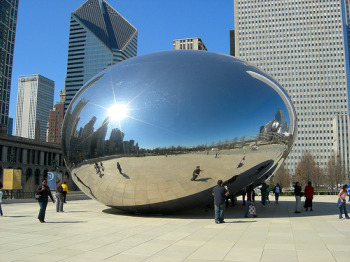 Anish Kapoor's Cloud Gate is the thing on every postcard, and nobody calls it Cloud Gate. It came out of a design competition in 1999. Park officials looked at the work of 30 artists and asked two for proposals. Jeff Koons pitched a permanent 150-foot playground slide with an observation deck. Kapoor pitched a drop of liquid mercury, and won.
Building it was harder than drawing it. The Bean is 168 stainless steel plates welded together and polished until the seams vanish, and it measures 33 by 66 by 42 feet and weighs 110 tons. Some experts said it couldn't be built. It was still unfinished at the park's opening in 2004, with the weld lines showing, and crews spent much of 2005 grinding and polishing before it was formally dedicated on May 15, 2006. It cost $23 million in private money, against an estimate of $6 million. Kapoor's contract says it should last 1,000 years.
Keeping it shiny takes work. Crews wipe down the lower six feet by hand twice a day with a Windex-like solution, and twice a year the whole thing gets a wash with 40 gallons of liquid detergent (Tide, according to Wikipedia). Walk underneath to the "omphalos," the dimple in the underside that multiplies your reflection into a crowd. The plaza around it was rebuilt from August 2023, and the Bean sat behind fences until June 23, 2024, so older trip reports complaining about the construction are out of date.
Go early. Before 8am you can get a photo of the skyline in the steel without a hundred strangers in it. By noon in summer, forget it.
Crown Fountain
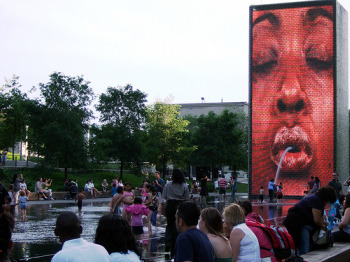 Spanish artist Jaume Plensa designed the Crown Fountain, named for Chicago's Crown family. Two 50-foot glass-block towers face each other across a black granite plaza covered in about a quarter-inch of water. LED screens behind the glass show the faces of roughly a thousand Chicagoans, filmed by students at the School of the Art Institute. Every few minutes a face purses its lips and a jet of water shoots out of the tower where its mouth would be.
Plensa expected people to look at it. Within hours of opening in 2004, kids had turned it into a splash pad, and it's been the best free way to cool off downtown ever since. The water runs from May into mid-October, weather permitting. The faces keep playing after the water shuts off. It's also the most argued-about thing in the park. When the city bolted surveillance cameras onto the towers in 2006, the public outcry was loud enough that they came down the next day.
Jay Pritzker Pavilion and the Great Lawn
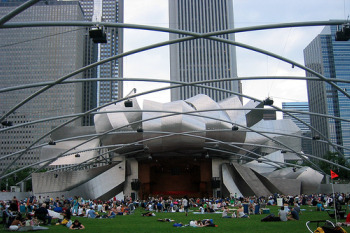 Frank Gehry's bandshell is the biggest thing in the park and the reason most locals come. The Jay Pritzker Pavilion has 4,000 fixed seats and room for 7,000 more on the Great Lawn, under a steel trellis that carries the sound system all the way to the back. Gehry turned the job down more than once. Cindy Pritzker changed his mind, with a $15 million family commitment toward the bandshell.
There's a legal trick behind it, too. Since the 1830s, the lakefront east of Michigan Avenue has been protected as public ground "forever to remain vacant of buildings," and Aaron Montgomery Ward spent years in court enforcing that. The city got the 139-foot pavilion past those limits by classifying it as a work of art rather than a building. The Harris Theater next door, a 1,525-seat hall for music and dance, went almost entirely underground for the same reason.
The Great Lawn is open for events only, and in summer there's something most nights: the Grant Park Music Festival's free classical concerts, the city's summer music and film series, and the Blues, Gospel, House and Jazz festivals. See our page on free summer events in Millennium Park and Grant Park for how each one works.
Lurie Garden
This is where to go when the Bean crowd gets to you. The Lurie Garden fills the southeast corner of the park (the city calls it 3.5 acres), and Dutch plantsman Piet Oudolf, who later did the planting on New York's High Line, designed its beds of prairie perennials and grasses. It was laid out as two "plates," a shady one of trees and ferns for the city's marshy past and a sunny one of perennials for its future. It looks good in October and November too, when the grasses turn.
The garden is sometimes closed, fully or partly, for work and around big events. It was shut for much of 2026. Check the garden's site before you plan around it. Enter from Monroe Street at Columbus Drive, across from the Art Institute's Modern Wing. From May to September, volunteers answer questions at a tent on the boardwalk on Fridays.
Bridges, columns and the rink
BP Pedestrian Bridge. Gehry's first bridge to get built snakes 935 feet over Columbus Drive into Maggie Daley Park. It has hardwood decking, so it closes in winter, because the city can't salt it or shovel snow onto the cars below. During events it's exit only.
Nichols Bridgeway. Renzo Piano's 620-foot footbridge runs from the south end of the Great Lawn over Monroe Street to the third floor of the Art Institute's Modern Wing. It's open during museum hours, and the view back at the skyline from the top is worth the detour. It closes during park events.
Wrigley Square. At Michigan and Randolph, the Millennium Monument is a near full-size copy of the semicircle of paired Doric columns that stood here from 1917 to 1953. The base lists the donors who gave $1 million or more to build the park.
McCormick Tribune Ice Rink. On Michigan Avenue between Washington and Madison, the plaza turns into one of the city's biggest outdoor rinks in winter. Skating is free, weather permitting, and you pay only to rent skates. In summer the same space becomes outdoor dining. The city's official Christmas tree has gone up next to the rink since 2015, and the lighting ceremony in late November kicks off the holiday season. More in our winter activities guide.
Boeing Galleries. The two terraces above Wrigley Square and the Crown Fountain host big outdoor art shows that often run for more than one summer.
Tours
From May to October, DCASE volunteers lead a free public art walking tour in and around the park on the first and third Saturdays of the month. Sign up through the city's visitor page. The free Chicago Greeter walks from the Cultural Center across the street also pass through. For boat, bus and bike options, see sightseeing tours in Chicago.