The Chicago Cubs
· Updated · BootsnAll
 Chicago has two Major League Baseball teams. The White Sox play on the South Side, and the Cubs play on the North Side at Wrigley Field. Ask a Cubs fan about the team and you'll get a family history, a grudge against a goat and, since 2016, a very specific memory of a rain delay in Cleveland. This page is the story. For tickets, getting to the ballpark, the bag policy and rooftop seats, see our guide to Chicago Cubs games.
A charter club
The Cubs are older than the league they play in. The club started in 1870 as the Chicago White Stockings and joined the new National League as a charter member in 1876, winning its first pennant that season (Wikipedia). They're one of only two charter franchises still around. Cap Anson, the game's first real superstar and the first player credited with 3,000 hits, led them to six pennants by 1886. Over the next few years they were the Colts, then the Orphans, and around 1902 a newspaper started calling the young roster the Cubs. The name became official a few years later. The old White Stockings name went to a new American League team on the South Side, which is how the city ended up with the White Sox.
1907 and 1908
For a few years the Cubs were the best team in baseball. The 1906 club won 116 games, still the best winning percentage in modern major league history, and then lost the World Series to the "Hitless Wonders" White Sox. The Cubs bounced back to win the World Series in 1907 and 1908, the first team to win it twice. The infield of Joe Tinker, Johnny Evers and Frank Chance was famous enough to get its own poem, "Baseball's Sad Lexicon," with its refrain "Tinker to Evers to Chance," written in 1910 by New York columnist Franklin P. Adams from the point of view of a weary Giants fan.
Then came the drought. The Cubs won pennants in 1910, 1918, 1929, 1932, 1935, 1938 and 1945 and lost every one of those World Series. The 1932 Series is the one where Babe Ruth supposedly called his home run at Wrigley.
Wrigley Field and the Wrigleys
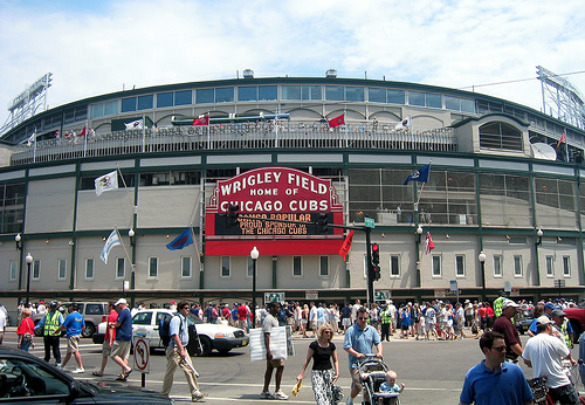
The ballpark wasn't built for the Cubs. It opened in 1914 as Weeghman Park for the Chicago Whales of the short-lived Federal League. When that league folded, Weeghman and advertising man Albert Lasker took control of the Cubs and moved them in, and they've played there since 1916. Chewing gum magnate William Wrigley Jr. became majority owner by 1921, and the park took his name in 1926. The bleachers and the hand-turned scoreboard date from a 1937 rebuild. The Wrigley family owned the team for 65 years and sold it to the Chicago Tribune in 1981 for $20.5 million.
Wrigley was the last big-league park to get lights, in 1988. Day games are still part of the team's identity, and one theory holds that all those afternoon games in the summer heat explain why Cubs teams so often faded in August and September.
The billy goat
In 1945, the Cubs were up two games to one in the World Series against the Detroit Tigers. For Game 4 at Wrigley, William Sianis, who owned the Billy Goat Tavern, showed up with his pet goat, Murphy. The goat was turned away, or thrown out, depending on who tells it, and Sianis supposedly declared, "Them Cubs, they ain't gonna win no more" (Wikipedia). The Cubs lost Game 4 and the Series. They didn't reach another World Series for 71 years.
The curse makes a good story, but the record is murkier than the legend. A Chicago newspaper account from the time says the goat was turned away at the gate and Sianis went in alone. It mentions a possible lawsuit but no curse. Newspaper columnist Mike Royko kept the story alive for decades. Sianis died in 1970, and his nephew Sam brought goats to Wrigley several times to try to lift the hex.
You can still eat at the Billy Goat Tavern on Lower Michigan Avenue, at 430 N. Michigan Ave. under the street. It's the place linked to the "Cheezborger, cheezborger" sketch on Saturday Night Live, and it has a location in Wrigleyville at 3724 N. Clark St., too.
Near misses
Cubs fans of a certain age can list the heartbreaks without stopping for breath. In 1969 they led the new NL East by as many as nine and a half games in August and finished eight behind the Mets. In 1984, with Ryne Sandberg winning MVP and Rick Sutcliffe going 16-1 after a midseason trade, they won the first two games of the best-of-five NLCS against San Diego and then lost three straight. In 1998, Sammy Sosa hit 66 home runs, won the MVP and helped carry them to the playoffs during his home run race with Mark McGwire.
The worst one came in 2003. The Cubs were five outs from the World Series, leading the Marlins 3-0 in Game 6 of the NLCS at Wrigley, when fan Steve Bartman reached for a foul ball that Moisés Alou thought he could catch. An error on a likely double play followed, the Marlins scored eight runs in the inning, and they won Game 7 the next night. The Cubs didn't win another playoff game for 11 years.
Two men kept fans going through the lean years. Harry Caray came over from the White Sox broadcast booth in 1982 and led Wrigley in "Take Me Out to the Ball Game" during the seventh-inning stretch until he died before the 1998 season. The singalong is still a Wrigley ritual. Ernie Banks, "Mr. Cub," played all 19 of his big-league seasons with the team, gave Wrigley its nickname, "the Friendly Confines," and is remembered for his line "Let's play two."
The Ricketts era and 2016
The Ricketts family bought the team and the ballpark from the Tribune Company in 2009, with Tom Ricketts as chairman. After the 2011 season he hired Theo Epstein, who had helped end the Boston Red Sox's own 86-year drought, and Epstein and general manager Jed Hoyer tore the roster down and rebuilt it around young players like Kris Bryant, Anthony Rizzo, Javier Báez and Kyle Schwarber. Joe Maddon took over as manager for 2015, and that team reached the NLCS.
In 2016 the Cubs won 103 games, beat the Giants and then the Dodgers, and clinched the pennant on October 22, the 46th anniversary of William Sianis's death. They fell behind Cleveland three games to one in the World Series and came back to force a Game 7 on November 2 in Cleveland (Wikipedia).
That game is the one people talk about. Dexter Fowler led off with a home run. The Cubs led 6-3 in the eighth, then Brandon Guyer doubled in a run and Rajai Davis tied it with a two-run homer off Aroldis Chapman. After nine innings, a 17-minute rain delay stopped play, and Jason Heyward pulled his teammates into a weight room behind the dugout for a talk that several of them later credited for what came next. In the 10th, Ben Zobrist doubled in the go-ahead run and Miguel Montero singled in another. Cleveland got one back, and Mike Montgomery, who had never recorded a save in the majors, got the final out on a grounder that Bryant threw to Rizzo. The Cubs won 8-7, their first title in 108 years, the longest championship drought in North American pro sports. The city estimated that more than five million people turned out for the parade and rally that ended in Grant Park.
Off the field, the Ricketts era has remade the ballpark. The $575 million 1060 Project renovation ran from 2014 to 2019 and added video boards, new clubhouses and the Gallagher Way plaza, and the family bought up most of the rooftops across the street. Wrigley became a National Historic Landmark in 2020. The same year, the team's games moved to its own Marquee Sports Network, ending a TV relationship with WGN that went back to 1948.
After the title
The Cubs made the playoffs every year from 2015 to 2018 and again in 2020 but never got back to the World Series. Epstein resigned after the 2020 season, and most of the 2016 core was traded away in 2021. Kyle Hendricks, the Game 7 starter, was the last one left when he departed after 2024. Under manager Craig Counsell, who came over from the rival Brewers in 2023, and with Kyle Tucker and Pete Crow-Armstrong in the lineup, the 2025 Cubs made the playoffs, beat the Padres in the Wild Card Series and then lost to Milwaukee in the Division Series.
Traditions to know before you go
- After a win, the Cubs raise a white flag with a blue "W" over the center field scoreboard, and a blue one with a white "L" after a loss. Fans fly their own "W" flags, and the team's social slogan is "Fly the W."
- Since 2007, Steve Goodman's "Go, Cubs, Go" plays after every home win. Goodman recorded it in 1984 and died that September, days before the Cubs clinched their first division title.
- Bleacher fans throw an opponent's home run ball back onto the field.
- The retired numbers fly on flags from the foul poles, including Banks's 14 and Santo's 10.
- Statues of Banks, Billy Williams, Ron Santo, Fergie Jenkins and Ryne Sandberg stand outside the park on Gallagher Way, and Harry Caray's statue is at Sheffield and Waveland, by the bleacher entrance (MLB.com). The Caray statue has been a pregame meeting spot for decades.
Our Cubs games page covers Wrigley Field tours. For the neighborhood, see where to eat and drink near Wrigley Field, hotels near Wrigley Field and our Lakeview guide.
Photo by wallyg