Seeing Stars at the Adler Planetarium
· Updated · BootsnAll
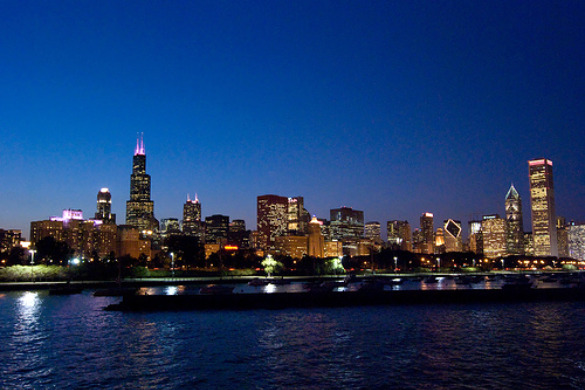
 The Adler Planetarium is still the museum on the Museum Campus that people skip. It doesn't have a T. rex like the Field Museum next door, or belugas like the Shedd. What it has is history and a view. Max Adler, a retired Sears executive, saw the new Zeiss planetarium in Munich and paid for Chicago to have one, and the Adler opened on his birthday, May 12, 1930, as the first planetarium in the Western Hemisphere. The Art Deco building by Ernest Grunsfeld Jr. has been a National Historic Landmark since 1987. It sits at the tip of Northerly Island, and the skyline view from its front steps costs nothing.
When I first wrote about the Adler, I found the exhibits heavy on reading. They're great if space is already your thing, and less so for small kids with short attention spans. The museum has added more to touch and climb since then, but the reason to buy a ticket is still the dome.
The dome shows
The Adler runs two dome theaters and a flat-screen theater, and the dome shows cost extra on top of museum entry. The Grainger Sky Theater is the original 1930 dome, 70 feet across, and the projection now wraps 190 degrees down to the floor. The Space Theater, which opened in 1999, has stadium seating under a tilted 55-foot dome.
Most shows run about 30 minutes. Skywatch Live is the one I'd pick first. A live presenter shows you the sky over Chicago on the day you visit, without the light pollution, so you can go outside afterward and find what you just saw. Dark Side of the Moon is 45 minutes of space visuals set to the Pink Floyd album. For small kids there's One World, One Sky, with Big Bird and Elmo. Check the museum calendar for showtimes, because the lineup rotates.
What else is inside
Mission Moon is the strongest exhibit. It follows Jim Lovell, the Gemini and Apollo astronaut who spent years working with the Adler, and it has the actual Gemini 12 spacecraft, a Moon rock and a notebook Lovell used on Apollo 13. Kids get a stomp rocket to launch up a tall tube.
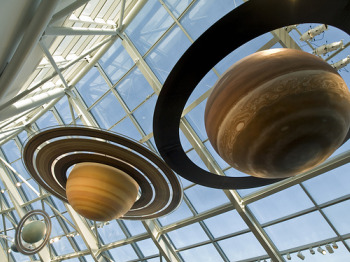
The collection of old instruments is the part most visitors walk past too quickly. Max Adler bought an antique collection in Amsterdam before the building opened, and the museum now says it holds the best sundial collection in North America, along with astrolabes, celestial globes and early telescopes. Look for the Atwood Sphere, a 1913 metal globe punched with 692 holes for the stars you could once see from Chicago. It's the oldest working sky simulator in the world, and you sit inside while it turns.
For younger kids, Planet Explorers is a climbing and crawling space, and the PlayLab has hands-on astronomy activities. Stars Aligned, one of the newer galleries, covers the centuries when astronomy and astrology were the same job.
One small thing to time for. If the sky is clear near sunset, light through the angled glass front doors throws rainbows across the Rainbow Lobby.
Go on a Wednesday night
The Adler keeps odd hours. It's open 9am to 4pm Thursday through Tuesday, and on Wednesdays it opens from 4pm to 10pm with timed-entry tickets. Last admission is an hour before close. The Wednesday evening is the better visit. You get the dome shows, then you walk out to the city lit up across the water. On clear Wednesday nights the Doane Observatory, a separate building on the lakeshore behind the museum, opens for public viewing through a 24-inch telescope, the largest public telescope in Chicago. It's weather-dependent, and the line can close early, so check the observatory page a day or two ahead and get there early.
The museum closes on Thanksgiving and Christmas Day, plus a few other dates each year that it lists on its plan your visit page.
Tickets
Museum entry starts at $25 for adults and $13 for kids, and dome shows are an add-on. Chicago residents get $5 off every ticket by entering their zip code at checkout. Illinois residents get in free on the Adler's Illinois Resident Discount Days, about 52 a year, which the museum posts a few months ahead (our free museum days page explains how they work). Families with a Link or WIC card pay $1 a head for up to six people at the box office.
If you'll be in town a while, the Star Pass ($65, or $180 for a family) gives a year of unlimited entry and dome shows. Visitors doing several big museums should look at CityPASS, where the Adler pick includes two dome shows. Our CityPASS vs. Go City comparison runs the numbers. Go City holders can't book ahead and have to go to the box office.
Getting there
The Adler is at 1300 S. DuSable Lake Shore Dr., at the far end of the Museum Campus. The closest L stop is Roosevelt (Red, Orange and Green lines), and the walk east from there is longer than the map suggests, and the Adler is the farthest of the three museums.The #146 bus runs from State Street and Michigan Avenue to the campus, and the #130 adds service from mid-May through Labor Day. Metra Electric trains stop at Museum Campus/11th Street. Parking belongs to the Park District, and rates jump when there's a game or concert at Soldier Field or Huntington Bank Pavilion, so check those schedules before you drive. There's no coat check or locker room, so pack light in winter.
Photo by thomas.merton