Bucktown/Wicker Park/Ukrainian Village/Logan Square
· Updated · BootsnAll
 Chicagoans still lump Bucktown, Wicker Park, Ukrainian Village and Logan Square together, and it's easy to see why. They sit side by side along the Blue Line northwest of the Loop, a few stops from downtown, and they share the same history. Polish and German immigrants built them in the late 1800s, and Puerto Rican and Black families moved in during the 1970s and '80s, when the blocks were grittier and gang crime was a real problem. Then the artists and musicians arrived, and after them the money.
When this page was first written, locals were already complaining that the area had gone "yuppie" and lost its edge. That argument is over, and the money won. Rents are high, the chain stores have found Milwaukee Avenue, and a lot of the dive bars are new bars dressed as old ones. It's still the best part of the city for walking around with no plan, because the independent shops, music rooms and restaurants are packed tighter here than almost anywhere else in the city.
Getting there
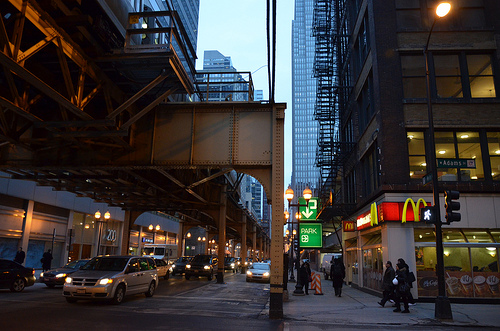
Take the Blue Line. Damen is the stop for Wicker Park and Bucktown, and it lets you out at the six-way intersection of North, Milwaukee and Damen, the center of everything. Division, one stop closer to downtown, is better for the Division Street strip and the south end of Wicker Park. Western drops you at the west edge of Bucktown, and California and Logan Square are the stops for Logan Square. Ukrainian Village has no L stop of its own, so walk south from Division or take the Western or Chicago Avenue bus. The Blue Line runs 24 hours and goes straight to O'Hare, which makes this one of the easiest neighborhoods to stay in if you're flying. Our transportation guide has fares and passes.
Wicker Park
Wicker Park is named after the 4-acre park at its center, which Charles Wicker and his brother Joel laid out when they bought 80 acres along Milwaukee Avenue in 1870. After the Great Chicago Fire, wealthy brewers and merchants built mansions on Hoyne Avenue and Pierce Avenue, just southwest of North and Damen. Hoyne was called "Beer Baron Row." Many of those houses are still standing, and a slow walk down those two streets is the best free architecture tour on the Northwest Side.
The commercial heart is Milwaukee Avenue running southeast from the six corners. Our shopping guide covers the stores, including Myopic Books, Reckless Records and Quimby's. For food, Big Star, 1531 N. Damen Ave., is the taco and whiskey bar across from the Damen stop, and its patio is one of the busiest in the neighborhood on a warm night. Irazu, 1865 N. Milwaukee Ave., has been serving Costa Rican food since 1990. It's open Tuesday to Saturday, 11am to 9pm, and closed Sundays. Piece, 1927 W. North Ave., brews its own beer and makes New Haven-style thin-crust pizza, open daily 11am to 10pm. It's a good break from deep dish.
If you want to see the neighborhood from above, the Up Room bar at The Robey, 2018 W. North Ave., is 13 floors over the six corners. The Robey is also the best-placed hotel in the area, and it's right on top of the Damen stop. More on both in our rooftop bars and hotels guides.
In summer, Wicker Park Fest takes over Milwaukee Avenue for a weekend in July with more than 50 bands, many of them local. It's the street fest we'd pick if you only go to one. See our neighborhood festivals page for the rest.
Bucktown and The 606
Bucktown sits north of Wicker Park, bounded by Fullerton Avenue to the north, Western Avenue to the west and the Kennedy Expressway to the east. The name goes back to the goats Polish families raised here in the 19th century. They called it Kozie Prery, or Goat Prairie. Today it's mostly quiet residential blocks, with shops and restaurants along Damen Avenue north of the tracks.
The best way to see it is from The 606. The old Bloomingdale freight line, which runs along Bloomingdale Avenue at the border of Bucktown and Wicker Park, reopened in 2015 as a 2.7-mile elevated trail. It starts at Ashland Avenue and runs west through Humboldt Park and Logan Square to the Ridgeway trailhead, with ramps down to four neighborhood parks along the way. It's open 6am to 11pm every day. Walk it in the morning, when it's mostly runners and dog walkers. On summer weekend afternoons it gets crowded with bikes, and they don't always slow down. The name comes from the first three digits that nearly every Chicago ZIP code shares.
At the corner of Western and Armitage, Margie's Candies, 1960 N. Western Ave., has been open since 1921. It still has the marble soda fountain, the Tiffany lamps and the booths with little jukeboxes, and the family says the Beatles came in for sundaes after their 1965 show at Comiskey Park. It's open until midnight Monday to Thursday and until 1am Friday to Sunday, and it's a short walk from the Western Blue Line stop. Order a sundae. The menu has more than 50.
For dinner, Club Lucky, 1824 W. Wabansia Ave., is an old-school Italian supper club with a cocktail lounge and a patio, open seven days. For a drink, the Map Room, 1949 N. Hoyne Ave., is a coffeehouse by day and a beer bar by night, with more than two dozen taps and a wall of old National Geographics. Our nightlife guide covers the rest of the area's bars.
Ukrainian Village
South of Division Street, Ukrainian Village is still the center of Chicago's Ukrainian community. The landmark is St. Nicholas Ukrainian Catholic Cathedral, 835 N. Oakley Blvd., finished in 1915 and modeled on St. Sophia's Cathedral in Kyiv. Its 13 domes stand for Christ and the Twelve Apostles.
A few blocks away, the Ukrainian National Museum, 2249 W. Superior St., has a permanent collection of embroidery from across Ukraine, and the Ukrainian Institute of Modern Art, 2320 W. Chicago Ave., shows contemporary work. Both keep short hours, so check their sites before you go.
The neighborhood also has two of the city's best reasons to leave downtown. Kasama, 1001 N. Winchester Ave., holds two Michelin stars for its Filipino tasting menu, but by day it's a counter-service bakery where you can eat without a reservation. See our Michelin guide for booking details. And the Empty Bottle, 1035 N. Western Ave., is the club where you catch a band before everyone else has heard of them.
Logan Square
Logan Square is where much of Wicker Park's music and bar crowd moved once Wicker Park got expensive, and now it's getting expensive too. The center is the square itself, where Logan Boulevard meets Kedzie and Milwaukee, marked by the tall column of the Illinois Centennial Memorial. The Logan Square Blue Line stop is right there. Logan Boulevard and the other boulevards around it are lined with big old graystones, and they're a good walk on a nice day.
The restaurant most people know is Longman & Eagle, 2657 N. Kedzie Ave., a whiskey bar, restaurant and small inn in one. It's on Michelin's Bib Gourmand list, and we wrote it up in Eat This: Longman & Eagle. For more on where to eat around here on a budget, see Chicago's best cheap eats.
Safety and getting around
Crime in these neighborhoods is much lower than it was when this page first went up, but use the same sense you would in any busy city neighborhood. Keep your phone in your pocket on the L platform, and don't leave anything visible in a parked car. Away from Milwaukee, Damen and North, the blocks turn residential fast. That's pleasant for walking but thin on taxis, so plan to walk back to the L, catch a bus or use a rideshare app.
If you only have a day, ride the Blue Line to Damen, walk Milwaukee Avenue, climb onto The 606 at Damen or Western, walk it west to Logan Square and take the train back from there. For more neighborhoods you can reach by train, see six neighborhoods to visit on the L.
Photo by cbnight