Exploring Chicago's Loop
· Updated · BootsnAll
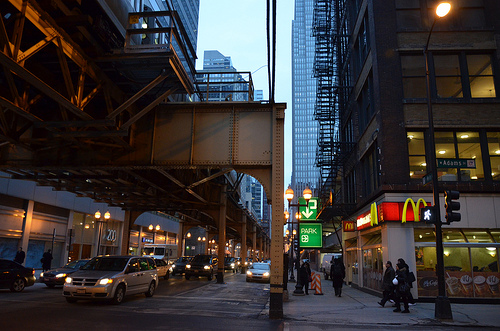
 The Loop takes its name from the ring the L tracks make around downtown, and it's Chicago's business core. Strictly speaking, the "Union Loop" of the L covers just 35 blocks, boxed in by Lake Street, Wells Street, Van Buren Street and Wabash Avenue. Since the 1920s, though, "the Loop" has meant the bigger area between the Chicago River on the north and west, the lake on the east and Roosevelt Road on the south. By that measure it's the second-largest business district in North America, behind Manhattan.
It's busy on weekday afternoons and a lot quieter at night and on weekends, especially in the office blocks along LaSalle Street. More people live here than you'd guess, about 42,550 in the whole community area as of 2024. You'll probably spend a lot of time here anyway, since the hotels, the theaters, Millennium Park and the Art Institute are all in or next to it. State and Madison is the zero point of the city's address grid, which helps when you're trying to figure out how far away "1500 North" is.
The architecture
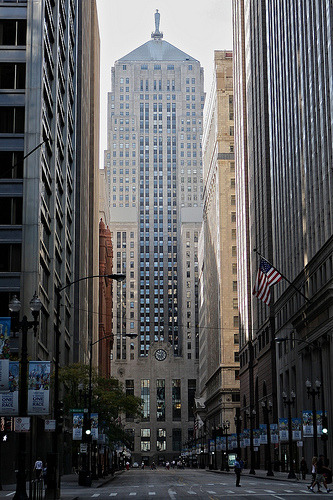
The Loop is where Chicago's reputation for architecture comes from. The easiest way in is the Chicago Architecture Center River Cruise, 90 minutes on a First Lady boat with a volunteer docent, leaving from 112 E. Wacker Dr. Tickets start at $57, and our attractions page explains why it's the one paid thing we'd do if you only do one. The Architecture Center itself is across the street at 111 E. Wacker Dr. and runs walking tours of the Loop too. See our sightseeing tours page for the other options.
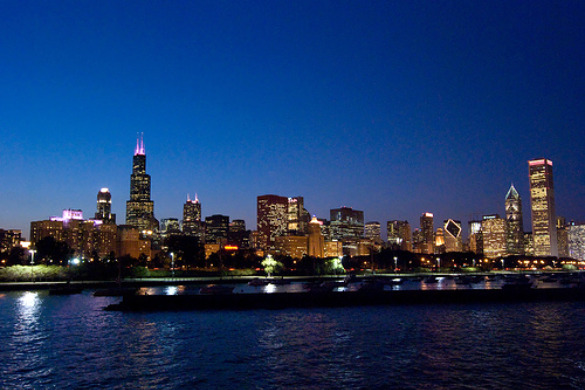
The Willis Tower, still called the Sears Tower by plenty of locals, opened in 1973 as the tallest building in the world and kept the title for nearly 25 years. It's now the third-tallest building in the Western Hemisphere, behind One World Trade Center and Central Park Tower in New York. Its Skydeck, on the 103rd floor, is the highest observation deck in the United States. For a comparison with the view from 360 CHICAGO on Michigan Avenue, see our observatory page.
A few older buildings are worth walking into. The Chicago Cultural Center, 78 E. Washington St., opened in 1897 as the city's main public library. It's free and open daily 10am to 5pm. Go up to Preston Bradley Hall for the 38-foot Tiffany glass dome, which the center says is the largest Tiffany dome in the world. It also runs free exhibitions and concerts, and the free InstaGreeter walks of the Loop leave from its Randolph Street entrance on Fridays, Saturdays and Sundays. The Richard J. Daley Center, the courthouse tower between Randolph and Washington, is clad in Cor-Ten steel that was designed to rust to its red-brown color. Across Clark Street to the northwest, Helmut Jahn's glass Thompson Center, which opened in 1985 as the State of Illinois Center, is being rebuilt as offices for Google.
Public art
You can see several major pieces in a short walk, and all of them are free.
- The Chicago Picasso, in Daley Plaza. The 50-foot untitled steel sculpture went up in 1967, and people have been guessing what it is ever since. Picasso's Afghan hound, a baboon and one of his models are the usual answers.
- Marc Chagall's Four Seasons, in Chase Tower Plaza. A 70-foot-long mosaic wrapped around all four sides of a box, dedicated in 1974.
- Alexander Calder's red Flamingo, in Federal Plaza, unveiled in 1974. Calder picked the red to stand out against the black steel of Mies van der Rohe's federal buildings around it.
- Jean Dubuffet's Monument with Standing Beast, outside the Thompson Center, dedicated in 1984.
- Cloud Gate, "the Bean," and the Crown Fountain in Millennium Park, which has its own page.
The Riverwalk
The Chicago Riverwalk runs along the south bank of the main branch of the river, from the lake and the Outer Drive Bridge west to Lake Street. It was built in stages starting in 2001, and the western sections opened in the 2010s. Walk it for the bridges and the buildings overhead, stop for a drink at one of the bars and cafes down at water level, or rent a kayak. The Vietnam Veterans Memorial is on the Riverwalk too. On summer evenings it's one of the busiest places in the city, so go in the morning if you want room to take pictures. The ways to get out on the water page has more boat options.
State Street and shopping
State Street is the Loop's shopping street, and it's more practical than glamorous. The anchor is Macy's, in the old Marshall Field's building at State and Washington. Walk in for the Tiffany mosaic ceiling and lunch in the Walnut Room. Filene's Basement, which the old version of this page sent you to, went out of business in 2011. Our shopping page covers the rest of the street and Michigan Avenue across the river, and the Magnificent Mile has its own page.
Theater, parks and festivals
The Loop is Chicago's theater district. The Goodman Theatre produces its own plays, and the CIBC Theatre and the James M. Nederlander Theatre host the touring Broadway shows. Our theatre guide has the details.
The lakefront side of the Loop is Grant Park, Chicago's front yard, with Buckingham Fountain and the festival grounds that host Lollapalooza in late July or early August. The Art Institute of Chicago is on Michigan Avenue at the edge of the park, not on the Museum Campus, as the old version of this page had it. The Museum Campus, south of Grant Park, has the Field Museum, the Shedd Aquarium and the Adler Planetarium. For the whole list, see museums in Chicago. From the Friday before Thanksgiving to Christmas Eve, the Christkindlmarket fills Daley Plaza, and our Christmas events page covers the rest of the season. Festival dates for the year are on our holidays and events page.
Where to eat and drink
A lot of Loop food is weekday lunch for office workers or expense-account steak. These are better than that, and all were open in 2026.
- The Gage, 24 S. Michigan Ave., across from Millennium Park. A gastropub in a landmarked row of 1890s buildings that once housed milliners. The kitchen runs until 11pm most nights, later on weekends, which is rare this close to the park.
- The Berghoff, 17 W. Adams St. A German restaurant that has been family-owned and family-run for more than 125 years. Eat German classics in the dining room, or have a beer from its own Adams Street Brewery at the bar.
- Italian Village, 71 W. Monroe St. Italian, family-owned since 1927, and a short walk from the theater district, which makes it an easy pre-show dinner.
For deep dish, Giordano's has a Loop location, and our pizza guide compares it with the other big names. For cheaper options, see dining on a budget, and for bars, try our nightlife page.
Staying and getting around
The Loop is the easiest base for a first trip, with every L line and all four downtown Metra stations within walking distance. Clark/Lake is served by the Blue, Brown, Green, Orange, Pink and Purple lines, and the Red and Blue lines run under State and Dearborn. For hotels, see our hotels in the Loop, and for other areas, where to stay in Chicago. North of the river, the next neighborhoods over are River North and the Gold Coast, the Magnificent Mile and Streeterville.
Photo by ewwhite