Lincoln Park
· Updated · BootsnAll
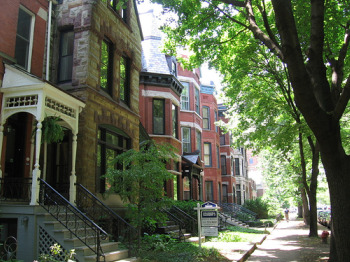 Lincoln Park is two things, and visitors mix them up all the time. There's the park, a long strip of green along Lake Michigan, and there's the neighborhood west of it, which took the park's name. The neighborhood runs roughly from North Avenue up to Diversey Parkway, and from the lake west to the Chicago River. Like a lot of the North Side, it was once home to many Puerto Rican families. Now it's one of the most expensive places to live in the city, with blocks of restored brick and stone houses that sell for well over $1 million.
The rich families share it with thousands of college students. DePaul University's main campus is here, so the same neighborhood with a free zoo and a nature museum also has a lot of bars that serve cheap pitchers to 22-year-olds. For a visitor that mix works well. You can spend the day in the park and the night on Halsted Street.
Getting there
Fullerton is the main L stop, served by the Red, Brown and Purple Lines, and it sits in the middle of DePaul's Lincoln Park campus. Armitage and Diversey on the Brown Line cover the west side of the neighborhood, and North/Clybourn on the Red Line is the stop for the south end. For the park and the zoo, the buses that run along Clark Street and Lake Shore Drive get you closer than the train. From Fullerton it's about a 20-minute walk east to the zoo. Our transportation guide has routes and fares.
The park
Lincoln Park covers 1,208 acres along the lake, which makes it the city's largest public park. The south end was a city cemetery in the 19th century, and during the Great Chicago Fire people fled to it to escape the flames. The Couch Mausoleum, a stone tomb near the Chicago History Museum, is the only part of that cemetery still standing, and it surprises people who walk past it.
The Lincoln Park Zoo is the big draw. It was founded in 1868 with a gift of two pairs of swans from New York's Central Park, and it's still free, open 365 days a year. The gates open at 8am and the animal houses at 10am. You'll pay only for parking. It's small enough to see in two hours. Our Lincoln Park Zoo page has more.
Right next to it, the Lincoln Park Conservatory is free too, with palms, ferns and orchids under glass. It's open 10am to 5pm with timed entry, so reserve a slot online first. On a January afternoon it's one of the best free ways to warm up in the city.
On Fullerton Parkway at the north end of the zoo, the Alfred Caldwell Lily Pool, 125 W. Fullerton Pkwy., is a small garden around a pond, designed by Alfred Caldwell and built from 1936 to 1938. It's a Chicago Landmark and one of the quietest spots in the park. It's open from mid-April to mid-November, from 7:30am until dusk or 7:30pm, whichever comes first.
Just across Fullerton, the Peggy Notebaert Nature Museum, 2430 N. Cannon Dr., opened in 1999 and is run by the Chicago Academy of Sciences. The reason to go is the Butterfly Haven, a warm glass room full of live butterflies. It's a good stop with kids. At the south end of the park, the Chicago History Museum, 1601 N. Clark St., is the best place to understand the city you're walking around. Adults pay $24, and it's closed most Mondays. See our museums guide for both.
In the warm months, the Green City Market sets up at the south end of the park, 1817 N. Clark St., on Wednesday and Saturday mornings from 7am to 1pm, and the outdoor season runs into November. It's our favorite farmers market in the city. Read more in our Green City Market post. And don't forget the lake. North Avenue Beach is at the park's south end, and the Lakefront Trail runs its whole length. See our beaches guide.
Armitage and Halsted
The intersection of Armitage Avenue and Halsted Street, a block from the Armitage Brown Line stop, is the neighborhood's shopping and dining center. Most of the chain boutiques the old version of this page listed are gone. Armitage now mixes national brands with long-running local shops like Art Effect, which has sold clothes, jewelry and gifts on Armitage for 40 years. Our shopping guide has more.
This short stretch of Halsted also has some of the city's most famous restaurants. Alinea, 1723 N. Halsted St., is Grant Achatz's modernist tasting menu and still the most famous meal in Chicago. Boka, a few doors up at 1729 N. Halsted, holds a Michelin star but lets you order à la carte. Our Michelin guide explains how to book both. For a less formal night, Café Ba-Ba-Reeba!, 2024 N. Halsted, has been serving Spanish tapas since 1985 and does brunch on weekends.
Steppenwolf Theatre, 1650 N. Halsted, is the company Gary Sinise co-founded in 1974, and it's one of the best theaters in the country. Book ahead. See our theatre guide for more. Farther north, Kingston Mines, 2548 N. Halsted, has been playing blues since 1968 on two stages and stays open until 4am on Fridays and Saturdays. Our blues and jazz clubs page has more.
More places to eat and see
R.J. Grunts, 2056 N. Lincoln Park West, across from the zoo, opened on June 10, 1971, and was the first restaurant from Lettuce Entertain You, now one of the city's biggest restaurant groups. It's still a burger-and-chili joint with a '70s look. For deep dish, Pequod's, 2207 N. Clybourn Ave., is famous for the ring of caramelized cheese around its crust. Expect a wait. More in our pizza guide.
On Lincoln Avenue, the Biograph Theater, 2433 N. Lincoln Ave., is where FBI agents shot John Dillinger on July 22, 1934, as he walked out of a gangster movie. The building is a Chicago Landmark, and you can look at the marquee from the sidewalk. A few blocks away at Lincoln and Webster, Oz Park has statues of the Tin Man, the Cowardly Lion, the Scarecrow and Dorothy with Toto, a nod to L. Frank Baum, the author of The Wonderful Wizard of Oz, who lived in Chicago in the 1890s. Kids love it.
At night, the bars around Lincoln, Halsted and Fullerton fill with DePaul students. If that's not your crowd, head south to Old Town or north to Lakeview. For a drink with a view, The J. Parker is the rooftop bar on top of Hotel Lincoln, 13 floors above the zoo.
Staying in Lincoln Park
Hotels are scarce. The main one is Hotel Lincoln, 1816 N. Clark St., across from the park. It's a good base if you'd rather wake up near the lake than in the Loop, and the Clark Street buses get you downtown. For other options, see our hotels page and where to stay in Chicago.
Photo by straightedge217