A Brief History of Chicago
Updated · BootsnAll
 Chicago exists because of a muddy portage. A short carry between the Chicago River and the Des Plaines River linked the Great Lakes to the Mississippi, and whoever controlled that gap controlled a route across half a continent. Almost everything in the city's story, from the fur trade to the rail yards to O'Hare, comes back to that idea of Chicago as the place where things change hands. Here's the short version, with links if you want to go deeper.
Before the city
People lived and traded around the mouth of the Chicago River long before Europeans showed up. When French explorers arrived in the late 1600s, the area was home to Algonquian-speaking nations, including the Miami, and by the 1700s the Potawatomi were the main people here, having followed the Miami, Sauk and Meskwaki. The name "Chicago" most likely comes from a Miami-Illinois word, šikaakwa, for the wild onion (or wild garlic) that grew along the river. Louis Jolliet and Jacques Marquette crossed the portage in 1673, the first Europeans on record to do so (History of Chicago).
The first non-Indigenous person to settle here for good was Jean Baptiste Point du Sable, a trader of African and possibly European descent. Older guides, this one included, called him a fugitive slave. There's no evidence for that. His birthplace and parents are unknown, and historians have dismissed the slave stories as fiction (Wikipedia). What we do know is that he married a Potawatomi woman, Kitihawa, and that by 1790 he was running a prosperous trading post at the mouth of the river. He sold up in 1800 and moved to Missouri. The city took a long time to give him credit. Pioneer Court, at 401 N. Michigan Ave., sits on the site of his homestead and has a bronze bust of him, the Michigan Avenue Bridge was renamed DuSable Bridge in 2010, and Lake Shore Drive became DuSable Lake Shore Drive in 2021.
Fort Dearborn and the land cessions
The U.S. Army built Fort Dearborn beside the river in 1803. During the War of 1812 the garrison was ordered to evacuate, and on August 15, 1812, the column was attacked by about 500 Potawatomi warriors near what's now Prairie Avenue. Of the 148 soldiers, women and children who left the fort, 86 were killed, and the fort was burned the next day. A second fort went up on the same spot in 1816 and was out of use by 1837 (Fort Dearborn).
The fort isn't "now the Michigan Avenue Bridge," as we used to say. Its outline is marked with plaques and a line set into the pavement at Michigan Avenue and Wacker Drive, at the south end of the DuSable Bridge. It's a quick detour on the way to the Magnificent Mile.
The Potawatomi, Odawa and Ojibwe ceded much of their land around Chicago in the 1816 Treaty of St. Louis. The 1833 Treaty of Chicago took the rest, roughly 5 million acres in Illinois and the Michigan Territory, and the Potawatomi were forced west of the Mississippi within a few years (1833 Treaty of Chicago).
Boom town
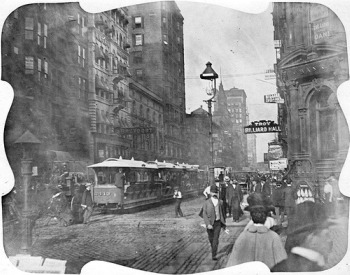
The Town of Chicago was organized in August 1833, when only a few hundred people lived here, and the state granted it a city charter on March 4, 1837. William B. Ogden was the first mayor. Then 1848 changed everything. The Illinois and Michigan Canal opened, running 96 miles from Bridgeport to the Illinois River, and the city's first railroad, the Galena and Chicago Union, started running the same year. The Chicago Board of Trade was founded that year too. By 1860, more than 30 rail lines came into the city, and Chicago was the country's great transfer point for grain, lumber and livestock.
The ground was the problem. Chicago sat on a swamp, the streets were so muddy that people put up joke signs reading "No Bottom Here," and sewage had nowhere to go. In the late 1850s the city started raising the downtown streets and buildings, jacking whole blocks up several feet, hotels included, to fit sewers underneath. Between 1850 and 1890 the population went from under 30,000 to more than a million.
The fire
The Great Chicago Fire started on the night of October 8, 1871, not in the summer as we once wrote, and burned until October 10. It began in or near the O'Leary family's barn behind their house on DeKoven Street, southwest of downtown, after a long, dry summer. Strong winds pushed it across the South Branch of the river, through the business district and over the main stem into the North Side. About 300 people died, more than 100,000 were left homeless, and about 17,500 buildings were destroyed across more than 3 square miles (Great Chicago Fire).
Nobody knows what actually started it. The story of Mrs. O'Leary's cow kicking over a lantern appeared in print almost at once, and the reporter who helped spread it later admitted it was made up. The City Council formally cleared Catherine O'Leary, and her cow, in 1997. The Chicago Fire Department's training academy now stands on the site of the barn, with a bronze sculpture called Pillar of Fire marking the spot where it began.
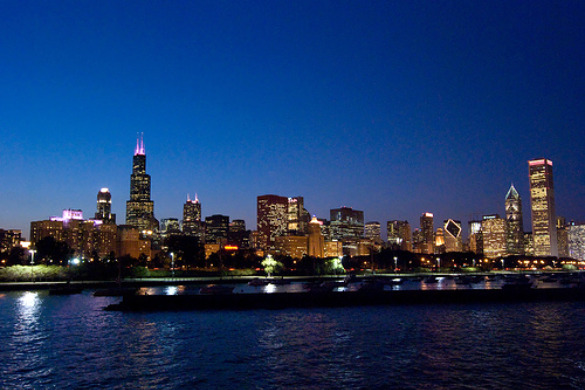
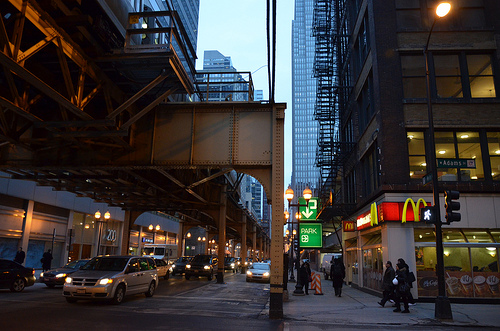
The rebuild is why Chicago looks the way it does. New fire codes pushed builders toward masonry, and the soft ground forced engineers to work out steel-frame construction. The result was the skyscraper, and a reputation for architecture that still brings people here for the river cruises.
The White City and the backwards river
Chicago beat New York, Washington and St. Louis for the right to host the World's Columbian Exposition, which ran from May 1 to October 30, 1893, in Jackson Park. Daniel Burnham ran the design, Frederick Law Olmsted laid out the grounds, and the white neoclassical buildings earned it the name "White City." It drew about 27 million visitors and introduced the Ferris wheel. One of the fair buildings, the Palace of Fine Arts, survives as the Museum of Science and Industry (World's Columbian Exposition).
Seven years later, the city pulled off something stranger. Sewage from the river was flowing into Lake Michigan, where Chicago gets its drinking water. The fix was the Chicago Sanitary and Ship Canal, opened in January 1900, which reversed the main stem and South Branch of the Chicago River so they flow away from the lake and on toward the Mississippi. The river has run backwards ever since (Chicago Sanitary and Ship Canal).
The Great Migration, gangsters and a second fair
When World War I cut off immigration from Europe, factories and stockyards needed workers, and Black Southerners came north by the hundreds of thousands. Chicago's Black population went from about 44,000 in 1910 to almost 234,000 in 1930, most of it confined by segregation to the "Black Belt" on the South Side. The migration brought the blues and jazz north with it, and it also brought violence. In the 1919 race riot, 38 people died and more than 500 were hurt. A second wave during and after World War II was even bigger.
Prohibition made Al Capone famous and gave the city a gangster image it has never fully shaken. We used to say the 1930s were when things turned around with the second World's Fair. That fair, A Century of Progress, actually ran in 1933 and 1934 to mark the city's centennial, and more than 40 million people went. It and the 1893 fair are two of the four stars on the Chicago flag. During World War II the Navy took over Navy Pier as a training center, and on December 2, 1942, Enrico Fermi's team ran the world's first self-sustaining nuclear chain reaction under the stands of the University of Chicago's old Stagg Field.
The Daley years and 1968
Richard J. Daley was mayor from 1955 until his death in 1976 and ran the city through the Democratic machine. His era gave Chicago its expressways and O'Hare, and a new round of towers. The John Hancock Center (now officially 875 North Michigan Avenue, home of the 360 Chicago observation deck) topped out in 1968, and the Sears Tower opened in 1973 as the tallest building in the world. It has been the Willis Tower since 2009, though plenty of locals still call it the Sears Tower.
It was also a hard decade. Riots followed the assassination of Martin Luther King Jr. in April 1968 and burned sections of the West and South sides. That August, anti-war protesters came to town for the Democratic National Convention, and police beat demonstrators, reporters and bystanders in Grant Park and on Michigan Avenue in front of the Conrad Hilton, on live television. A federal commission later called it a "police riot" (1968 DNC protests).
Harold Washington and after
Jane Byrne became the city's first woman mayor in 1979. In 1983 Harold Washington, a congressman from the South Side, beat both Byrne and Richard M. Daley in the Democratic primary and then won a close general election to become Chicago's first Black mayor. His first term was eaten up by "Council Wars" with a white-majority bloc of aldermen. He won again in 1987 and died in office that November (Harold Washington). The central public library on State Street is named for him.
Richard M. Daley, the old mayor's son, ran the city from 1989 to 2011. He tore down most of the big public housing high-rises and built Millennium Park, which opened in 2004. The stockyards and most of the steel mills had closed by then, and Chicago leaned harder on finance, medicine, universities and tourism. On election night in 2008, Chicagoans packed Grant Park to hear Barack Obama, their former state senator, claim the presidency. Rahm Emanuel followed Daley, then Lori Lightfoot, the city's first Black woman mayor and first openly gay mayor, in 2019. Brandon Johnson, a former Chicago Public Schools teacher, took office in 2023.
The city peaked at about 3.6 million people in 1950 and counted 2.74 million in the 2020 census, still third in the country. In June 2026, the Obama Presidential Center opened in Jackson Park, on the same lakefront where the White City stood in 1893. For the neighborhoods that grew out of all this, start with our Chicago information page.
Photo by Thundercheese