Transportation
Updated · BootsnAll
 Chicago is an easy city to get around without a car. The L and the buses cover nearly everywhere a visitor wants to go, downtown is flat and walkable, and Divvy bikes and scooters fill the gaps. For the suburbs, Metra's commuter trains are cheap and quick, and the South Shore Line runs to the Indiana Dunes and South Bend. You can rent a car, but downtown hotel parking is expensive and street parking is scarce in most neighborhoods, so skip it unless you're leaving the city. Our car rental page covers when a car makes sense.
For getting from O'Hare and Midway into town, see the airports page. For how the street grid works, see the map of Chicago.
Fares below come from the CTA fare chart, Metra, Divvy and the city's taxi rate sheet, and were current in September 2026.
The L
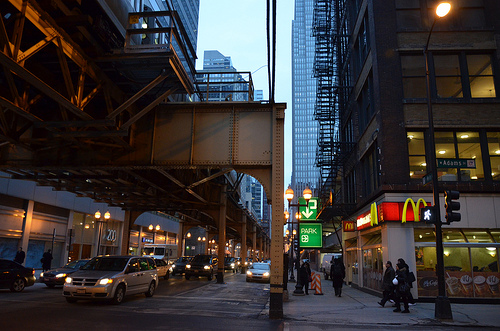
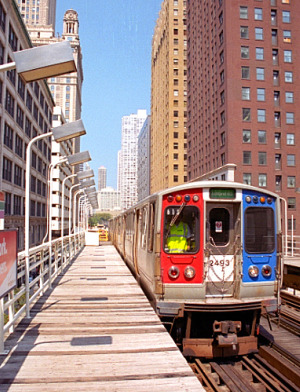
Chicago's rapid transit system is the "L," short for elevated, though parts of it run underground, at street level and down the middle of expressways. The first stretch opened in 1892. Today the Chicago Transit Authority runs eight color-coded lines over 224 miles of track, with 146 stations. The Red and Blue Lines run 24 hours a day, every day (CTA), which only a handful of cities in the world can say.
The Red Line is the one you'll ride most. It runs from Howard, on the Evanston border, south through Rogers Park, Uptown (Lawrence is the stop for the Green Mill), Wrigleyville (Addison), Lakeview and Lincoln Park, then under State Street through downtown, and on down the Dan Ryan Expressway to 95th Street. Get off at Cermak-Chinatown for Chinatown and Sox-35th for the White Sox at Rate Field. An extension south to 130th Street is under construction.
The Blue Line runs from O'Hare through Logan Square, Wicker Park (Damen) and under Dearborn Street through the Loop, then west down the Eisenhower Expressway to Forest Park. It's the airport train, and the one for Wicker Park and Logan Square.
The Brown Line runs from Kimball in Albany Park, through Lincoln Square, Lakeview and Lincoln Park, and around the elevated Loop. It stops at Belmont, Fullerton and Armitage, and it's the prettiest ride in the system, at second-floor-window height past the North Side's brick three-flats. The Purple Line runs from Linden in Wilmette through Evanston to Howard, and on weekday rush hours it runs express down to the Loop.
The Orange Line connects Midway Airport with the Loop. The Green Line runs from Harlem/Lake in Oak Park through the West Side and the Loop, then south to Bronzeville and splits for Ashland/63rd and Cottage Grove. The Pink Line goes from the Loop through Pilsen (18th Street) to 54th/Cermak in Cicero. The Yellow Line is a three-stop shuttle from Howard to Skokie, and it's the only line that doesn't go downtown.
Oak Park is an easy trip on the Green Line. See things to do in Oak Park, and neighborhoods to visit on public transportation for more ideas.
Paying your fare
You don't need to buy anything special to ride. Tap a contactless credit or debit card, or a phone or watch with a mobile wallet, on the reader at the turnstile or on the bus. You can also use a Ventra card or the Ventra app. A ride costs $2.50 on the L and $2.25 on the bus, and that fare covers up to two more rides within two hours. Boarding at O'Hare costs $5. If you pay cash on a bus, you pay $2.50 and get no transfer, and the L doesn't take cash at the gate at all.
If you'll ride more than twice a day, get a pass. Passes are good on CTA trains and buses and on Pace suburban buses, and they start with your first ride.
- 1-Day pass: $5
- 3-Day pass: $15
- 7-Day pass: $20
- 30-Day pass: $75
You can't load a pass onto a bank card. Buy one in the Ventra app, or buy a Ventra card at a station vending machine or a store that sells them. A new Ventra card costs $5, and you get the $5 back as fare credit if you register the card within 90 days. Station machines also sell a 1-Day ticket for $5 and a single-trip ticket for $3, which is good for three rides within two hours. The 3-Day ticket is sold only at the O'Hare and Midway stations, and since a pass covers the $5 O'Hare fare, it's worth buying one on arrival.
The Ventra app also sells Metra tickets and a Regional Day Pass, which covers the CTA, Metra and Pace for one day.
Riding the L
Rush hour runs roughly 7 to 9:30am and 4 to 6:30pm on weekdays, and the Red, Blue and Brown Lines get crowded then. Platforms are signed by the last stop, so northbound on the Red Line is "Howard" and southbound is "95th/Dan Ryan." The front and side signs on each train show where it's going. If you get on the wrong train, get off at the next stop and cross over. It happens to everybody.
Take your backpack off in a crowded car, don't put your bag on the seat, give up the seats near the doors to anyone older or disabled, and move into the middle of the car so more people can get on. On escalators, stand on the right and walk on the left. The Train Tracker and Bus Tracker show real arrival times, and so do Google Maps and Transit. Planned weekend track work comes up often, so check the CTA's alerts before you head out. Late at night, ride in the first car, where the operator is.
All CTA buses and train cars are accessible, and 110 of the 146 stations have elevators or ramps. The CTA accessibility page lists which ones, and which elevators are out of service.
Buses
The CTA runs 127 bus routes (CTA), and they fill in everywhere the L doesn't reach, especially east-west across the city and along the lakefront. The routes to know are the 146 Inner Lake Shore/Michigan Express, which runs between the Museum Campus and Berwyn on the North Side by way of Michigan Avenue and Lake Shore Drive, and the 151 Sheridan, which runs up Michigan Avenue and through Lincoln Park. The 22 Clark and 36 Broadway work the North Side neighborhoods, and the 66 Chicago runs out to Navy Pier. Several routes run all night as Owl service. You get on at the front and tap your card or phone at the reader.
Metra
Metra is the commuter rail system for the suburbs, with 11 lines running out of four downtown stations: Union Station, Ogilvie, LaSalle Street and Millennium Station. Fares go by zone, and the one-way ticket prices are on Metra's fare page. For visitors, the passes are the better deal:
- A $10 All-Day Pass gives unlimited rides on every Metra line all day, until 3am the next morning.
- A $7 Saturday or Sunday Day Pass covers one weekend day, and a $10 Weekend Pass, sold only in the Ventra app, covers both.
Buy tickets in the Ventra app or at the station before you board. If you buy on the train at a station where an agent was on duty, there's a $5 surcharge. Weekend trains run less often, so check the schedule.
The Metra Electric line out of Millennium Station, below Randolph Street at Michigan Avenue, is the fast way to Hyde Park and the Museum of Science and Industry (see how to get there). Metra also works for day trips, so see day and overnight trips from Chicago. The trains to Milwaukee are Amtrak's, not Metra's. See Milwaukee to Chicago.
The South Shore Line
The South Shore Line is an old electric interurban line. It runs from Millennium Station, with stops at Van Buren Street, Museum Campus/11th Street and 57th Street, through northwest Indiana to South Bend International Airport. Along the way it stops at Dune Park, Beverly Shores and Miller, which are the stops for Indiana Dunes, the best beach trip you can make from Chicago without a car. Bikes are allowed year-round at designated stations. See getting to South Bend for more.
Divvy bikes and scooters
Divvy, the city's bike share, has docks all over town, with classic bikes, e-bikes and scooters, and you unlock them all in the Divvy or Lyft app. A single ride on a classic bike costs $1 to unlock plus 20 cents a minute. E-bikes and scooters cost $1 plus 44 cents a minute. A $19.90 day pass gives you unlimited classic-bike rides of up to three hours each for 24 hours, which is the way to do the Lakefront Trail.
Shared scooters come from Divvy and Lime. The city's rules say no riding on sidewalks, the Lakefront Trail, The 606 or the Riverwalk. Riders must be 18, or 16 with a parent's consent. Scooters top out at 15 mph, and at the end of a ride you lock the scooter to a bike rack, sign pole or something similar (City of Chicago). Chicago has an extensive bike lane network. It also has plenty of drivers who ignore it, so wear a helmet.
Taxis and rideshare
Taxis are easy to hail downtown and in the busier North Side neighborhoods, and they take cards. The meter starts at $3.25 and adds 31 cents per ninth of a mile (about $2.79 a mile) and 31 cents for every 45 seconds of waiting. Since July 1, 2026, there's a $2.50 surcharge from 3:30 to 7pm and a $1 surcharge from 8pm to 6am. The first extra passenger costs $1, each one after that 50 cents, and paying by card adds 50 cents. Tip 15 to 20%.
Uber and Lyft work across the city. Prices jump when surge pricing kicks in after concerts and games, and that's when a cab or the L can be the cheaper ride. At the airports, rideshare pickup is in marked zones, not at the curb. The airports page has the details.
Water taxis
Two companies run water taxis, and a ride doubles as a cheap river tour. Chicago Water Taxi, run by Wendella, has two routes and four stops: Michigan Avenue, Ogilvie/Union Station in the West Loop, Chicago Avenue and Chinatown. The Chinatown run is the one worth doing. It's cashless, and a one-way ticket covers one ride between any two docks. Shoreline links Navy Pier, Michigan Avenue, Union Station/Willis Tower and the Museum Campus, and an adult day pass starts at $36. Shoreline usually runs from May through September, and its boats aren't wheelchair accessible. Both depend on the weather, so check the schedules on the day. The ways to get out on the water post has more.
Walking and the Pedway
Walking is the best way to see downtown. The Loop, River North, Streeterville and the Magnificent Mile are all within a 30-minute walk of each other, and the Riverwalk and the lakefront are the best walking routes. Our map page explains the grid.
Under and above the Loop runs the Pedway, a network of tunnels and bridges that links more than 50 buildings across about 40 blocks, around five miles in all. It connects to the CTA, Metra and South Shore stations, and it started in 1951 with tunnels between the Red and Blue Line subways. Much of it runs through private buildings and keeps their hours, so don't count on every section being open at night or on weekends. On a January weekday, though, it's the best way to cross the Loop without going outside. The city has a Pedway map.
Driving and parking
Driving in Chicago isn't hard. Parking is the problem. Downtown garages and hotel valet charge a lot, and the city adds a parking tax on top. Street parking downtown is metered and fills early. In the neighborhoods, read every sign, because many streets are permit-only, and street-cleaning days and snow routes get cars towed. Apps like SpotHero and ParkWhiz let you book garage space ahead, often for less than the drive-up rate. For renting a car, see our car rental page. For road trips, see starting Route 66 in Chicago.
Photo by David Paul Ohmer