Gay Chicago
Updated · BootsnAll
 Chicago has a longer gay history than most people expect. In 1924 Henry Gerber filed papers with the State of Illinois for the Society for Human Rights, the first formal gay rights organization in the country. Police raided Gerber's apartment the next summer, and the society was finished by 1925. The Old Town rowhouse where he lived, on Crilly Court, was made a Chicago Landmark in 2001 and a National Historic Landmark in 2015. It's a private home, so look from the sidewalk.
The city's first Pride march set off on June 27, 1970, a year after Stonewall. Chicago hosted the Gay Games in 2006, and City Hall has backed the Chicago LGBT Hall of Fame since 1991. Today the scene centers on two North Side neighborhoods, a few miles apart on the Red Line.
Northalsted
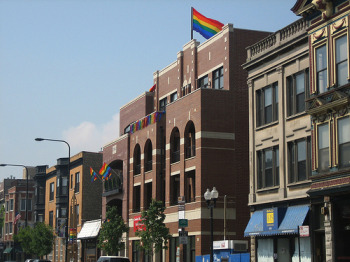
For decades everyone called the stretch of Halsted Street north of Belmont "Boystown." After a 2020 Chicago Reader piece criticized the name for leaving out everyone who wasn't a gay man, the local business association started calling the district Northalsted. Plenty of people still say Boystown, and nobody will blink if you do. The neighborhood sits inside Lakeview, and our Lakeview page covers the rest of it.
The heart of it is Halsted between Belmont and Grace. The rainbow pylons along the sidewalk went up in 1998, as part of Mayor Richard M. Daley's $3.2 million streetscape project, which made this the first gay neighborhood in the country officially recognized by a big-city government. Watch the crosswalks, too. Halsted has 14 rainbow crosswalks, kept up partly with donations from the neighborhood's street festivals. Take the Red Line to Belmont or Addison, or the 8 Halsted bus.
The Legacy Walk
The pylons double as an outdoor museum. The Legacy Walk, dedicated in October 2012, puts bronze plaques on them honoring LGBTQ people who shaped history, in Chicago and far beyond it. There were 50 by 2024, and new ones are added around the anniversary each October. Walk it on your own, or book a guided tour through the Legacy Project's site.
Center on Halsted
Center on Halsted is the neighborhood's LGBTQ community center, in a building at Halsted and Waveland that opened in 2007 after a $20 million fundraising campaign. It runs youth services, senior programs and a statewide HIV and STD hotline, and its public events calendar is a good way to find out what's happening while you're in town. There's a Whole Foods on the ground floor if you need snacks.
The bars
- Sidetrack, 3349 N. Halsted. Opened in 1982 with beer cases for seats, it now spreads across several storefronts and levels and can hold more than 1,000 people. Monday is show tunes night, and the Friday show tunes happy hour is just as popular. Open until 2am most nights and 3am on Saturdays.
- Roscoe's, 3356 N. Halsted. Right across the street, and open since 1987. It has a dance floor, drag shows, a fireplace and a sidewalk patio. You need to be 21 with ID.
- Hydrate, 3458 N. Halsted. The late-night dance club, open until 4am, or 5am on Saturday nights.
- Charlie's, 3726 N. Broadway. A block east of Halsted, and the place people end up after the Halsted bars close. It's open until 4am every night.
For more ideas, see our nightlife guide.
Andersonville
A couple of miles north, Andersonville grew into Chicago's other LGBTQ neighborhood after Women & Children First, the feminist bookstore at 5233 N. Clark, moved up from Lakeview. Lesbians followed it in the 1990s, and for a while people called the area "Girlstown." Rents have climbed since, but Clark Street is still an easy, friendly neighborhood strip with a Swedish streak (the Swedish American Museum is at 5211 N. Clark). Get off the Red Line at Berwyn and walk west.
- Meeting House Tavern, 5025 N. Clark, is the neighborhood's LGBTQ hangout.
Howard Brown Health, the city's LGBTQ health center, has clinics on Halsted and on Clark. Its Brown Elephant resale shops in Northalsted and Andersonville are good for a browse, and the money goes to its health care. Our shopping page has more on Andersonville's stores.
Pride Month
June is the big month. The Chicago Pride Parade is on the last Sunday in June and starts at 11am. It steps off at Grace and Broadway, heads south on Halsted to Belmont, then east and south on Broadway, and ends by entering Lincoln Park at Diversey. It's free to watch, and attendance estimates in recent years have run past a million, so pick your curb early and expect the Red Line to be packed. Bars along the route open early, and the party runs well past the parade's end.
Chicago Pride Fest is a separate event, a two-day street festival on Halsted held the weekend before the parade. Expect music stages, the Chicago Gay Men's Chorus and around 150 food and merchandise vendors. Entry is a suggested donation, and bags are checked at the gates.
Pride isn't the only big weekend. Northalsted Market Days fills Halsted from Belmont to Addison over a weekend in August, and the Haunted Halsted Halloween Parade takes over the street in October. Our pages on Chicago in June and neighborhood festivals cover what else is on.
Photo by hubbuzz.com