Grant Park: Chicago’s Front Yard
Updated · BootsnAll
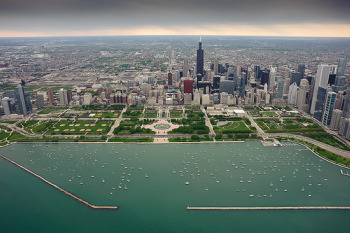 Chicagoans call Grant Park "the city's front yard," and the name fits. It's the strip of green between the Loop and Lake Michigan, running from Randolph Street south to Roosevelt Road, with Michigan Avenue on the west side and the lake on the east. The Chicago Park District puts it at just under 313 acres. Most first-time visitors end up here without planning to, because the Art Institute, Millennium Park, Buckingham Fountain and two of the big museums all sit inside it.
The land was set aside in the 1830s as "public ground forever to remain vacant of buildings," was named Lake Park in 1847 and became Grant Park in 1901, after Ulysses S. Grant. Mail-order king Aaron Montgomery Ward spent years suing to keep buildings out, and won at the Illinois Supreme Court in 1911. That's why the park still feels so open, and why the Art Institute on its western edge is the exception rather than the rule.
The basics
Entry is free. The park is open daily from 6am to 11pm. A few big festivals close sections of it behind ticket gates each summer, so check the calendar before you plan a picnic on a July weekend.
Buckingham Fountain
This is the centerpiece, at Columbus Drive and Congress Parkway. Kate Buckingham paid for it in memory of her brother Clarence, and it was dedicated on August 26, 1927. It's built of pink Georgia marble with bronze sea horses, and the bottom pool is 280 feet across.
According to the Park District, the fountain runs from about early May to mid-October, 8am to 11pm. In a normal season, the big show starts on the hour from 9am, lasts 20 minutes and sends the center jet 150 feet up. After dusk, lights and music are added, and the last show of the night starts at 10:35pm. Go after dark if you can. The lighting was designed to look like "soft moonlight," and it still does.
In 2026 the Park District set out 100 movable metal chairs around the fountain, the kind you see in the Luxembourg Gardens in Paris. People liked them, and Lollapalooza is paying for another 100, so there will be 200 chairs from May 2027. Grab one for the sunset show.
Millennium Park
The northwest corner of Grant Park used to be rail yards and parking lots. Millennium Park opened on top of them on July 16, 2004, four years late, and it's now the busiest part of the whole park. It covers 24.5 acres and sits over a garage and rail lines, which makes it one of the largest rooftop gardens in the world. The city's cultural affairs department runs it, not the Park District, and it's open daily from 6am to 11pm with free entry (city page).
- Cloud Gate, the stainless steel sculpture by Anish Kapoor that everyone calls the Bean. Come early in the morning for photos without a hundred strangers in them.
- Crown Fountain, two glass-block towers that show faces of Chicagoans and spit water on the kids splashing below. It's the best free way to cool off downtown in July.
- Jay Pritzker Pavilion, the Frank Gehry bandshell. The Grant Park Music Festival, a free ten-week classical series that has run every summer since 1935, plays here, as do plenty of other free concerts and films. Bring a blanket and get to the lawn early.
- Lurie Garden, a 3.5-acre garden of mostly native plants.
- BP Pedestrian Bridge, Gehry's snaking steel bridge over Columbus Drive, which drops you into Maggie Daley Park.
For the summer schedule, see our page on free events in Millennium Park and Grant Park.
Maggie Daley Park
East of Millennium Park, where Daley Bicentennial Plaza used to be, is Maggie Daley Park, which opened in December 2014. If you have kids, this is the part of Grant Park they'll remember. There's a huge playground, climbing walls and, in winter, a skating ribbon that winds over the hills with the skyline behind it. The Park District says a lap is twice as long as a lap of a normal rink, and you can rent skates on site. In summer the ribbon is used for roller skating and scooters.
The Art Institute and Museum Campus
The Art Institute of Chicago is at 111 S. Michigan Ave., on the western edge of the park. It's not on the Museum Campus, as older guides (this one included) used to say. Plan at least half a day for Seurat's A Sunday on La Grande Jatte, American Gothic and the Impressionist rooms.
The Museum Campus is the 57-acre southeast corner of the park, with the Field Museum, the Shedd Aquarium and, out on the Northerly Island peninsula, the Adler Planetarium. The walk out to the Adler gives you the best free skyline view in the city. For tickets and free days, see our museums in Chicago page.
Festivals and big events
Grant Park is where the city throws its biggest parties, and where it gathered on November 4, 2008, to hear Barack Obama's election night victory speech.
- Lollapalooza is still in Grant Park, for four days in late July or early August. Setup and teardown fence off a big chunk of the park for days around the festival, so if you want a quiet walk, pick another week.
- Taste of Chicago is back in Grant Park in July, with free admission. You pay for food and drink.
- The Chicago Blues Festival is no longer a Grant Park event. It moved to Millennium Park, where it runs in early June, with an opening night at the Ramova Theatre in Bridgeport and free shows on several Millennium Park stages from June 5 to 7. It's still the largest free blues festival in the country.
- The Chicago Marathon starts and finishes in Grant Park. It's held on a Sunday in October.
- The NASCAR street race that shut down the park around July 4 from 2023 to 2025 is gone. NASCAR skipped 2026 and won't be back in Grant Park in 2027 either.
Getting there
The drive along the lake is now DuSable Lake Shore Drive. The city renamed it in 2021 after Jean Baptiste Point du Sable, the city's first non-Indigenous settler, though most locals still just say "Lake Shore Drive." Driving is a bad idea for festivals. There are several garages under the park along Michigan Avenue if you must.
By train is better. The Red Line stops at Monroe, Jackson and Harrison under State Street, two blocks west of the park, and the Blue Line stops at Monroe and Jackson one block further west on Dearborn. Up on the Loop tracks, trains stop at Washington/Wabash (which replaced the old Randolph/Wabash station in 2017) and Adams/Wabash. Roosevelt, on the Red, Green and Orange lines, is closest to the Museum Campus. From the suburbs, Metra Electric and South Shore Line trains stop at Millennium Station, Van Buren Street and Museum Campus/11th Street, all inside or right next to the park. Buses run the length of Michigan Avenue.
For more on the neighborhood around the park, see our guide to exploring Chicago's Loop.
Photo by mreioval