Accommodation
Updated · BootsnAll
 Chicago has a lot of hotel rooms, and it needs them. Conventions at McCormick Place, Cubs season, Lollapalooza in Grant Park in late July or early August, and the Chicago Marathon on a Sunday in October all fill the city, and rates jump to match. Pick dates away from those and competition works in your favor, especially from October to April outside the holidays, when the wind off the lake keeps a lot of visitors home.
The bigger decision is where to stay. Downtown puts you next to the museums and the lakefront. The neighborhoods put you where Chicagoans eat and drink. The L makes either choice workable, so it comes down to what you want outside your door at 10pm.
Where to stay
The Loop
Every L line meets here, Millennium Park and the Art Institute are a short walk away, and the hotel stock runs from grand old places like the Palmer House to newer boutique hotels. The Loop is busy on weekdays and quiet at night and on weekends, which some people like and some find eerie. It's the easiest base for a first visit. See our hotels in the Loop and our walking guide to exploring the Loop.
River North
Just across the river, River North has more restaurants and nightlife than the Loop, plus galleries and a heavy concentration of mid-range and boutique hotels. It stays lively after dark, and the Grand Red Line stop and Merchandise Mart on the Brown and Purple Lines cover the area. Our River North hotel picks go into detail.
Magnificent Mile and Streeterville
This is Michigan Avenue north of the river, with the shopping, the big luxury hotels and Navy Pier a walk to the east. It's the priciest part of town to sleep in and the most tourist-focused, but you can walk to the lake and Oak Street Beach. Chicago and Grand on the Red Line are the nearest stations. Start with our hotels near the Magnificent Mile and the Gold Coast, Mag Mile and Streeterville guide.
West Loop
If food is why you're coming, stay here. Randolph Street and Fulton Market hold most of the city's hardest reservations, and the old warehouses now house design hotels like the Hoxton and Nobu. It's a short walk to the Loop, and Morgan on the Green and Pink Lines sits in the middle of it. Weekend nights get loud.
Lincoln Park and Lakeview
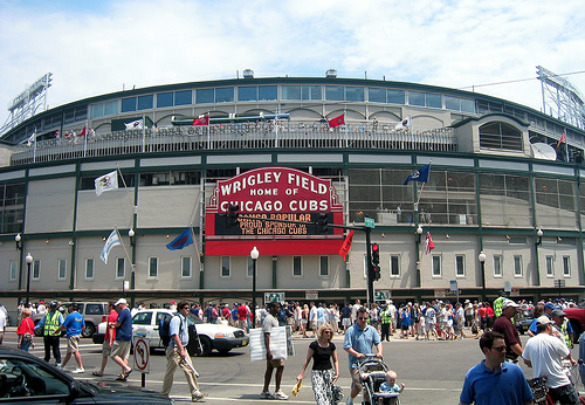
These are the North Side neighborhoods most visitors picture when they think of living in Chicago: brick three-flats, the zoo, the lakefront path and a lot of bars. There are few hotels, so you'll pay a premium for the ones that exist, and on Cubs game days anything near Wrigley Field fills fast. The Red and Brown Lines run straight downtown. See our guides to Lincoln Park and Lakeview, and our hotels near Wrigley Field.
Wicker Park
Wicker Park and neighboring Bucktown have the independent shops, music rooms and bars, and a couple of good small hotels. The Blue Line stops at Damen and Division, which gets you to the Loop in a few stops and to O'Hare without a change. Our Bucktown guide covers the area.
For a longer comparison, read where to stay in Chicago. We'd skip airport hotels unless you have a dawn flight. The O'Hare and Midway pages explain when they make sense.
Hotels, hostels and B&Bs
Our Chicago hotels page has picks by area and budget. Solo travelers and anyone counting every dollar should read our guide to hostels and other alternatives, which also covers B&Bs. To see how lodging fits into a full trip budget, try how to budget for a trip to Chicago.
The hotel tax is steep
The rate you see on a booking site usually isn't the rate you'll pay. The combined city, county and state tax on a Chicago hotel room is about 17.5%. Since May 2026, hotels with 100 or more rooms in the new Tourism Improvement District, which covers downtown, the Near North Side, McCormick Place, the Illinois Medical District and Hyde Park, add a 1.5% charge on top, which puts most big downtown hotels at around 19%. That's the highest hotel tax of any big American city. Check the final total, taxes included, before you book.
Airbnb and other short-term rentals
Renting an apartment still makes sense for longer stays or groups, but Chicago regulates it closely under its shared housing ordinance. Every legal listing needs a city registration number shown on the platform. In single-family homes and buildings with two to four units, the rental has to be the host's primary residence, and only one unit can be rented. Bigger buildings can have a quarter of their units or six, whichever is fewer. Units in a Restricted Residential Zone or on the city's Prohibited Buildings List can't be rented at all, and neither can places where the lease or condo association bans it (the eligibility rules are on the city's site).
For you as a guest, that means looking for the registration number on the listing, since a Chicago listing without one isn't legal. Expect more tax, too, since rentals pay a 6% city surcharge on top of the 4.5% city hotel tax, per the Department of Finance.
Photo by SolarWind-Chicago