The Gold Coast, the Magnificent Mile, and Streeterville
· Updated · BootsnAll
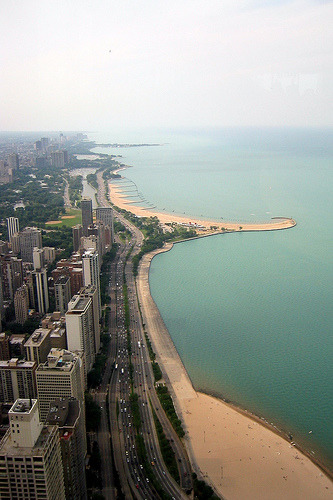 North of the Chicago River, three neighborhoods run into each other along the lake. The Magnificent Mile is the shopping strip on North Michigan Avenue. Streeterville is the high-rise district between the avenue and the lake. The Gold Coast, north of Oak Street, is old money, with mansions, grand apartment buildings and the steakhouses that go with them. Most visitors spend at least an afternoon up here, and plenty stay in its hotels.
The Magnificent Mile
The Mile runs along Michigan Avenue from the river to Oak Street. It's changed a lot since this page first went up in 2010. Big stores like Macy's and Saks Fifth Avenue have left, a lot of storefronts sat empty after the pandemic, and newer shops are filling some of them back in. The architecture is still the draw, from the Wrigley Building and Tribune Tower at the river to the Water Tower, which survived the 1871 fire. Our Magnificent Mile guide walks it block by block, with the stores, the Lights Festival and places to eat.
The old version of this page suggested a horse-drawn carriage ride. You can't do that anymore, since the city banned horse-drawn carriages starting January 1, 2021. Walking is the way to see it.
Streeterville
Streeterville runs from the river north to the Gold Coast, and from Michigan Avenue east to the lake. Most of it sits on landfill that used to be a sandbar, and the name comes from one of the city's better con men. In the late 1880s George Streeter said his boat ran aground on a sandbar off the shore. When landfill built up around it, he claimed the new land as his own, calling it the "District of Lake Michigan," and kept pressing that claim for decades, sometimes by criminal means. In his 1902 land fraud trial, a contractor testified that Streeter had shoreline filled in on purpose to muddy the land titles.
Today it's hotels, condo towers, Northwestern University's Chicago campus and its medical center, and some of the tallest buildings in the city. The black tower at 875 N. Michigan, the old John Hancock Center, has the 360 CHICAGO observation deck on the 94th floor. Navy Pier sticks out into the lake at the southern end of the neighborhood, next to Ohio Street Beach. Our things to do at Navy Pier page covers it.
The Museum of Contemporary Art, 220 E. Chicago Ave., is a block east of Michigan Avenue, near the Water Tower. Adult tickets are $22, or $19 for Chicago residents. Anyone 18 and under gets in free, and Illinois residents get in free on Tuesdays from 5 to 9pm. It's closed Mondays and open late on Tuesdays until 9pm. Its restaurant, Marisol, has food from Chicago chef Jason Hammel.
The Gold Coast
The Gold Coast Historic District is roughly bounded by Oak Street, North Avenue, Clark Street and Lake Shore Drive. It went on the National Register of Historic Places in 1978.
The old version of this page had the history backward. The area didn't lose its shine when Potter Palmer, the Palmer House hotel owner, built his mansion. His mansion is why the Gold Coast exists. In 1882 Palmer moved up from Prairie Avenue on the South Side and filled in swampy land along the lake that became Lake Shore Drive. His 42-room castle went up there, and the rest of Chicago's rich followed him north. The castle was torn down in 1951, but the streets behind it are still lined with the mansions and apartment buildings that followed.
The best walk is up Astor Street. At 1365 N. Astor is the Charnley-Persky House, finished in 1892 and designed by Louis Sullivan with his young draftsman Frank Lloyd Wright. It's one of the few buildings both men had a real hand in, and it's a National Historic Landmark. The Society of Architectural Historians, which has its headquarters there, runs tours on Wednesdays and Fridays from 12 to 1pm, and on Saturdays, year-round at noon and at 10am from April to October. If you want more Wright, it's an easy L ride out to Oak Park.
On Lake Shore Drive, the International Museum of Surgical Science, 1524 N. Lake Shore Dr., is one of the stranger museums in town. It's in an old lakefront mansion, with galleries on the history of surgery and a lot of instruments you'll be glad nobody uses anymore. It's open Mondays too, which helps since many museums aren't.
At the south end of the neighborhood, Oak Street is the high-end boutique block, and the pedestrian tunnel under Lake Shore Drive gets you to Oak Street Beach. See our beaches page. A few blocks west, the bars and steakhouses around Rush and Division still earn the nickname the Viagra Triangle. Our nightlife page has more on it.
Where to eat and drink
- Gibsons Bar & Steakhouse, 1028 N. Rush St. The Rush Street original, open since 1989, and the center of the Viagra Triangle scene. Book ahead, or try for a seat at the bar.
- Le Colonial, 57 E. Oak St. French-Vietnamese food with a dress code (the restaurant asks for "refined dinner attire"), so leave the gym clothes at the hotel.
- The Drake Hotel, 140 E. Walton Pl., for afternoon tea in the Palm Court or a martini in the Coq d'Or. More on both on the Magnificent Mile page.
- Marisol, inside the MCA (see above), if you're already at the museum.
For drinks with a view, see our rooftop bars, and for deep dish near the Mile, the pizza guide.
Getting there and staying
The Red Line runs under State Street with stops at Grand, Chicago, and Clark/Division. Clark/Division is the one for the Gold Coast, Chicago is the one for the Water Tower and the MCA, and Grand is closest to the south end of the Mile. Several CTA buses run up Michigan Avenue if you'd rather not walk the whole way. From the Loop, the south end of the Mile is a short walk across the river.
This is the priciest part of the city to sleep in. See our hotels near the Magnificent Mile and where to stay in Chicago for other neighborhoods. Across the river is the Loop, and just west is River North.
Photo by wallyg