Why You Should Add Chicago to Your RTW Trip
· Updated · BootsnAll
 On a lot of round-the-world routes, North America is just a place to change planes. Chicago deserves more than a layover, and the airline map makes it an easy stop to add. O'Hare is a hub for both United and American, which means it's a home base for two of the three big airline alliances. That matters more on an RTW ticket than on almost any other kind of trip.
Figuring out your itinerary is one of the hardest parts of planning a trip like this. Our sister site BootsnAll has an around-the-world travel guide it has kept up for years, including a step-by-step RTW planning framework. Start there. This page covers where Chicago fits.
Two alliances, one airport
United was one of the five airlines that founded Star Alliance in 1997, and it's headquartered downtown in the Willis Tower. American was a founding member of oneworld, which launched in 1999. Both run hubs at O'Hare, and both alliances sell round-the-world fares. Star Alliance's Round the World fare covers its member airlines. oneworld sells a continent-based oneworld Explorer and a distance-based Global Explorer.
Alliance fares come with rules. On Star Alliance's, for example, you start and end in the same country, travel in one direction, cross both the Atlantic and the Pacific, and make between 2 and 15 stops, with the whole trip lasting from 10 days to a year. Chicago fits that shape well, either as the start and end of the loop if you live in the Midwest, or as your North American stop between the two oceans. Because both United and American connect so much through O'Hare, it's often a natural place to break the journey on either alliance.
The partner airlines are here too. From the Star Alliance side, O'Hare has nonstops on Lufthansa from Frankfurt and Munich, LOT from Warsaw and Kraków, ANA from Tokyo, EVA Air from Taipei, Air India from Delhi, Ethiopian from Addis Ababa, EgyptAir from Cairo, Copa from Panama City, Avianca from Bogotá and Air Canada from Toronto, Montreal and Vancouver. On the oneworld side, there's British Airways from London Heathrow, Japan Airlines from Tokyo Haneda, Cathay Pacific from Hong Kong, Qatar Airways from Doha and Royal Jordanian from Amman, plus American's own flights to Heathrow. Emirates and Etihad fly in from the Gulf as well, outside either alliance. Routes change every season, so check the airline's schedule before you build around one.
The one big gap is the South Pacific. There are no nonstops from Australia or New Zealand, so you'll connect through Los Angeles, San Francisco or Dallas on that leg.
You don't have to stick to one alliance
An alliance pass works best when your stops line up with one alliance's network and you can live with its rules. Plenty of routes don't line up. AirTreks, BootsnAll's sister company, has been building round-the-world and multi-stop tickets since 1987. Its routes aren't limited to one alliance or one direction, and its multi-city planner takes up to 25 stops, including legs you plan to cover by train or bus. If you want Chicago in the middle of a route that mixes airlines from different alliances, or none, that's the kind of ticket AirTreks puts together. You can browse sample routes that start in Chicago, like this westbound loop through Tokyo, Bangkok, Bangalore, Nairobi and Madrid, and change the cities to price your own.
Chicago is also the hub of Amtrak's long-distance network. The Empire Builder runs to Seattle and Portland, the California Zephyr to the Bay Area and the Southwest Chief to Los Angeles. If you'd rather see the middle of the country than fly over it, fly into Chicago, take the train west, and pick up your transpacific flight on the coast. See getting to Chicago and getting from Los Angeles for the trains.
How long to stop
Airlines treat a short connection and a real stop differently. On the Star Alliance fare, anything under 24 hours is a transit and anything longer is a stopover. Other fares draw the line elsewhere, so ask before you book. AirTreks explains the difference in its guide to planning a stopover.
A day in Chicago is better than nothing. Two to four days is the right length. That's enough to see downtown, get into a neighborhood or two and recover from jet lag before the next long flight. If you're coming off a transpacific leg, your body clock will be well off, and the city is an easy place to fight it by staying outside until dark.
What to do with two to four days
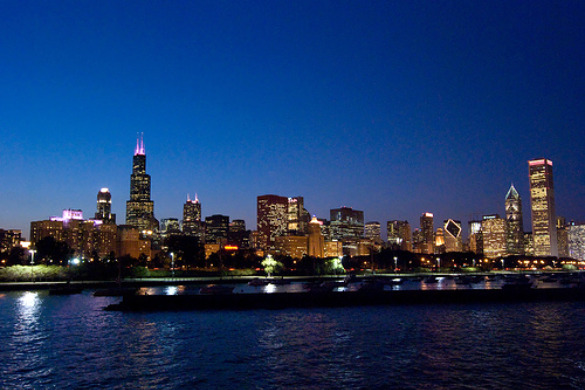
Day one. Take the Blue Line from O'Hare, about 40 minutes and $5 to the Loop, or buy a $15 3-Day pass from the machines at the airport and stop thinking about fares. Walk Millennium Park, then take the Chicago Architecture Center river cruise. It's 90 minutes, runs from mid-March to late November, and is the fastest way to understand why people come here for the buildings. End the day with a view from the Willis Tower Skydeck or 360 CHICAGO.
Day two. Spend the morning at the Art Institute (closed Tuesdays and Wednesdays) or on the Museum Campus. Our museums guide will help you pick. Eat a Chicago-style hot dog or deep dish for lunch. At night, take the Red Line to Lawrence for jazz at the Green Mill, which is cash only. The Red Line runs all night.
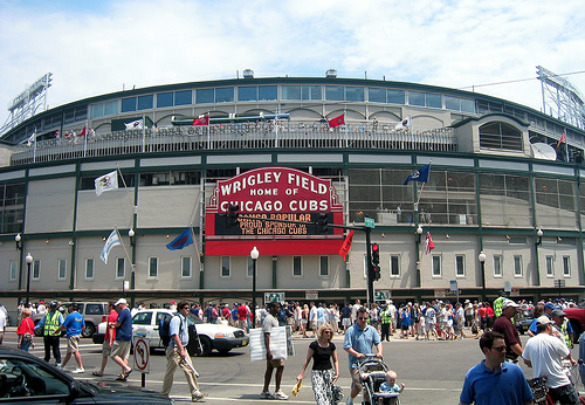
Days three and four. This is where Chicago earns its place on the route. Long-term travelers tend to want the parts of a city where people live, and Chicago's neighborhoods are the best thing about it. Eat tacos in Pilsen, browse the shops in Wicker Park and Bucktown, walk the lakefront in Lincoln Park, or go to Hyde Park for the Museum of Science and Industry. Take the Green Line to Oak Park for Frank Lloyd Wright's studio and blocks of Prairie-style houses. In summer, add a Cubs game at Wrigley Field or an afternoon at the beach. Our neighborhoods by L guide and three-day itinerary have more detail.
Practical notes for a stopover
- International arrivals come into Terminal 5 at O'Hare. Moving between Terminal 5 and Terminals 1 to 3 means clearing security again unless you're on a same-day connection. O'Hare is also in the middle of a long rebuild, so give yourself extra time. Our airports page has the details.
- Money matters on a long trip. HI Chicago in the Loop is the best-placed hostel, with dorms and private rooms. See hostels and how to budget for Chicago.
- Pick your season. Summer is the best time to be here and the most expensive. January through early March is cheapest, and cold enough that you'll need more than an RTW packing list usually allows. The weather page has the numbers.
If you're still sketching the route, start with BootsnAll's round-the-world guide. When you have a list of cities with Chicago on it, AirTreks can price the whole thing as one ticket.
Photo credit: ifmuth